
Getting Started in Software (2010)
I started my career in 2010 in software engineering. I barely knew Java. After joining TCS, we were given three months of training before being placed on a project. Anyone who didn’t know a programming language could learn the basics during that time.
The purpose of the training was simple: prepare software engineers to write, test, and support software.
I was interviewed for a C# role that I didn’t know, but I managed to convince the manager I could pick it up since its syntax was similar to Java. Over the next two years, I wrote a lot of code in both C# and Java—using Microsoft frameworks and open-source tools.
There was no concept of “deployment pipelines.” We used to ship the executable file to clients over email. Honestly, the most lines of code I’ve ever written were during those TCS years. That might be why I actually learned programming.
My role didn’t require meetings, didn’t involve managing infrastructure, didn’t involve microservices or operations. I could focus purely on writing quality software.
Of course, the software didn’t scale. It ran on one machine. Scaling and deployment were manual jobs. I used to do that over the weekend when traffic was low. And yes, the server would go down during deployment.
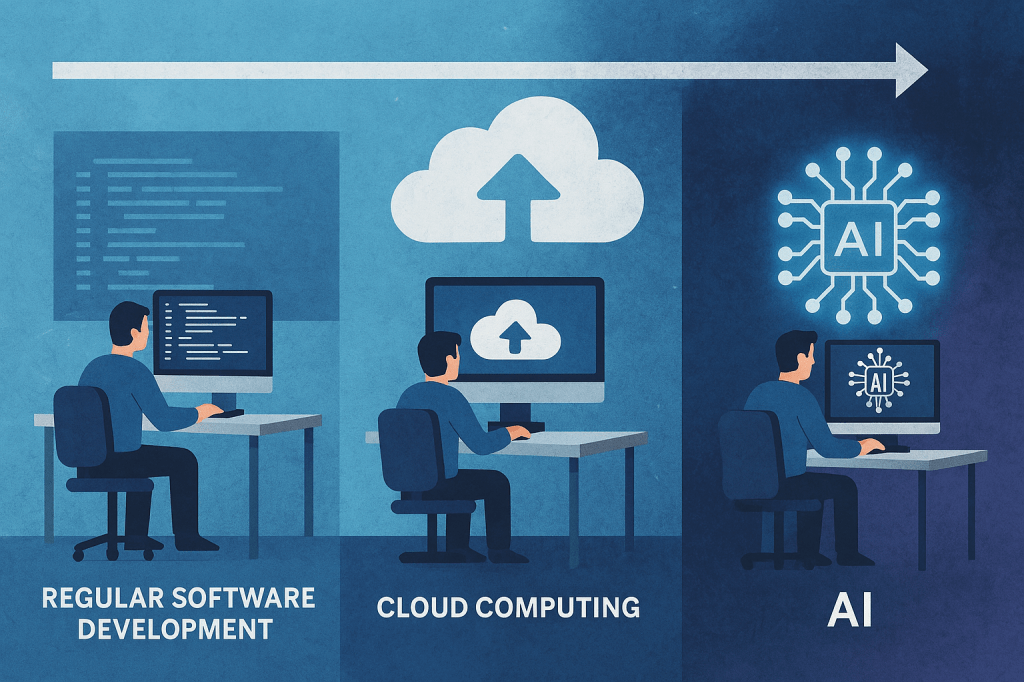
Then came the cloud—promising to solve all of that.
The Cloud Changed the Game—and the Workload
Cloud computing promised to reduce developer work by automating infrastructure provisioning and deployment. In reality, it increased the demand for software—so developers had to do more than just write code.
The instance, the deployment, the “cloud” itself—it became a black box. It needed more training. It meant managing infrastructure, understanding microservices, writing CI/CD pipelines. Developers had to handle more boilerplate and more context-switching.
Cloud computing didn’t eliminate traditional software engineering roles—but it redefined the value of skills. Jobs that involved cloud technologies started paying more. If you wanted to grow or earn more, you had to learn how the cloud worked. Regular dev roles that didn’t involve cloud began to stagnate in pay.
Upskilling was no longer optional.
And for years, we kept up.
Now It’s 2025. AI Is Here.
Just like the cloud did a decade ago, AI now promises to reduce complexity for developers.
But will it?
Here’s what we know.
AI tools have become a central part of the modern development workflow. According to the 2024 Stack Overflow Developer Survey, 76% of developers are already using or planning to use AI. OpenAI’s ChatGPT leads the adoption with 82% usage, followed by GitHub Copilot at 44% and Google Gemini at 22%.
These tools help developers generate code, fix bugs, write tests, explain libraries, and sometimes even suggest better architecture. They allow us to focus on the parts of software that matter—logic, structure, clarity.
But just like cloud computing, AI won’t eliminate software jobs—it will just shift where the value is.
In the cloud era, traditional development didn’t vanish. But cloud-savvy engineers started getting paid more. Those who learned to manage infrastructure-as-code, containers, and CI/CD pipelines saw faster career growth. The rest struggled to keep up. Upskilling wasn’t optional anymore—it was survival.
AI is following the same path, but faster.
I once asked ChatGPT to write a FastAPI endpoint for a GET request with filtering and pagination. It gave me 90% of the working code. All I had to do was fix the DB query logic and add proper exception handling. It saved me an hour.
And it’s not just endpoints. These days, I’m no longer spending time writing API models, generating unit tests, or learning new syntax in a programming language. AI handles the scaffolding. I just review, tweak, and move on.
The impact is real. A McKinsey report found that generative AI could automate up to 30% of software development tasks, especially routine code, tests, and documentation.
The Myth: AI Will Make Software Development “Easy”
Let’s be clear: AI will automate a lot of things. It already writes functions, explains errors, generates tests, and helps scaffold entire projects.
That doesn’t mean the job gets easier.
It means everything speeds up—and the expectations rise with it.
More automation → shorter timelines → tighter sprints → higher pressure.
We saw the same thing with the cloud. Infrastructure got faster, so businesses started building more products, more often. The number of software projects exploded. Everyone wanted an app, a dashboard, an API—because the barrier to build went down.
AI is doing the same. But faster.
Instead of removing the workload, it reshapes it. The developer who once had two weeks to deliver a module might now get two days. Because “Copilot can help you, right?”
So yes—AI will boost productivity.
But it’ll also increase stress, velocity, and scope creep.
Software Evolves Fast. AI Evolves Faster.
With AI, this rate of change will only accelerate.
What used to shift in years now moves in weeks. And software is the easiest thing for AI to automate—because both are built on bits. They speak the same language.
So if you think, “This won’t affect me anytime soon,” you might already be behind.
We’ve been here before—with the cloud. But this time, the change is moving faster than ever. And staying relevant will mean more than just writing code. It’s happening now.
In the next post, I’ll talk about how software engineers can keep up—not just by learning AI tools, but by shifting how we think and work.
