
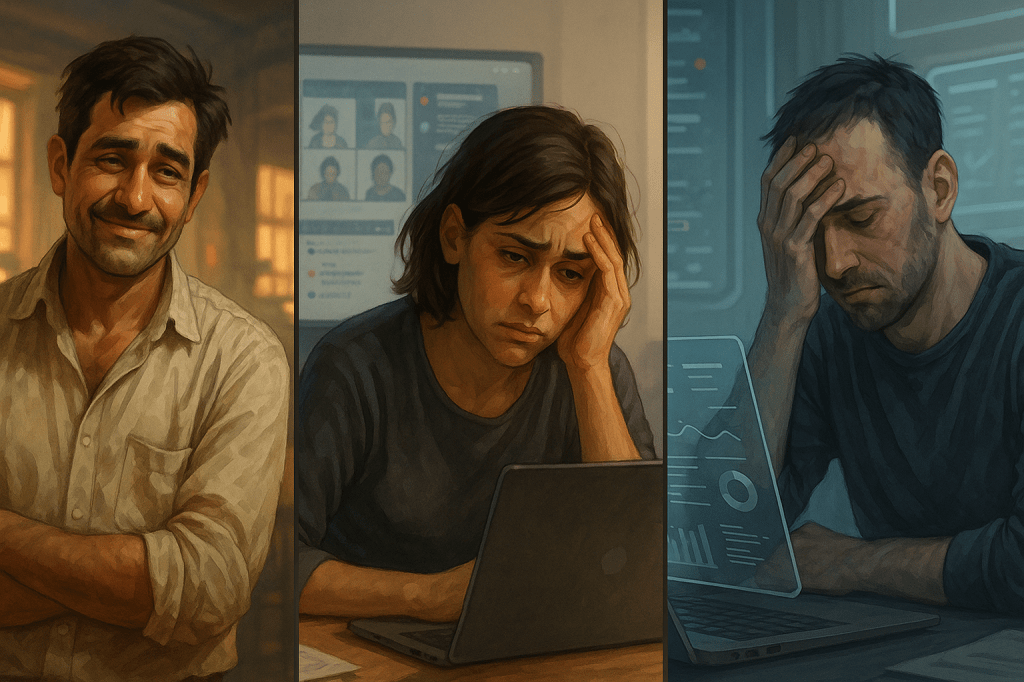
We’ve all said it—“I’m burnt out.” Usually with a sigh, a coffee in hand, or after closing yet another Zoom call. But here’s the thing: burnout isn’t always about long hours. Sometimes it’s what happens when the work just doesn’t fit who you are anymore.
In recent years, you’ve likely seen headlines declaring a “burnout epidemic.” This isn’t just media noise. In 2023, Gallup reported that 59% of U.S. employees experienced burnout symptoms, with even higher rates among remote workers and Gen Z. And it’s not just an American problem—this is a global, cross-industry shift.
So the deeper question is this: Is burnout actually increasing—or are we finally seeing it for what it is? Did people burn out before Slack, Zoom, and AI copilots? And if technology brought us flexibility and speed, why hasn’t it made work more livable?
This piece dives into those questions—not with stats alone, but through stories. Because to truly understand burnout, we need to stop treating it like a glitch in motivation. It’s not about weak willpower. It’s about misaligned systems.
Instead of blaming “bad bosses” or “too many emails,” let’s zoom out. Let’s look at how work itself has evolved—across three eras:
- The pre-technology era, when stress came from long hours and limited control—but work was tangible, social, and time-bound.
- The post-technology era, where we gained flexibility, speed, and autonomy—but lost boundaries, ownership, and emotional connection.
- And the AI-integrated near-future, where we may do more than ever—yet feel less involved than ever before.
Yes, technology changed work—and much of it for the better. But it also quietly reshaped how work feels, how we connect, and how we find meaning. In other words: it upgraded the machine without upgrading the human experience.
Whether you’re a teacher, nurse, software engineer, retail worker, or freelancer—if your daily work involves screens, shifting expectations, or managing disembodied tasks—you’re part of this shift.
This isn’t about nostalgia for old office cubicles. It’s about realizing that burnout isn’t caused by laziness or fragility—it’s the emotional bill of work systems that moved faster than humans could adapt.
Let’s understand how we got here—and more importantly, how we move forward.
Section 1: Before Technology – Ravi (1995)
Ravi rolls up to the textile factory gate just before 9:00 AM, the hem of his shirt fluttering in the dusty wind, still damp from his 20-minute morning cycle. The security guard waves him in, calls him “Ravi bhai,” and hands him the attendance sheet. Inside, the looms are already humming—a comforting, mechanical rhythm that signals things are running as they should.
He starts his day the same way every day: walking the floor, greeting each of the 20 workers on his shift. They make eye contact. They talk. By 9:30, he’s already solved a scheduling issue between two junior workers and has stopped to inspect a machine that seems slightly off-rhythm.
At 10:10, the thread on one of the looms snaps. It happens. A worker flags Ravi, who walks over, bends, inspects the mechanism, and calls out instructions. Within 15 minutes, the loom is working again. The team doesn’t need Jira tickets or status updates—they trust Ravi’s experience. The problem is visible. The fix is immediate. Feedback is physical: fabric is rolling again.
Ravi doesn’t use terms like “autonomy” or “clarity”—but he has both. His responsibilities are well defined. His team respects him. And even when the work is intense, there’s a rhythm to it—a sense of ownership that makes the sweat worthwhile.
He heads home at 6:15 PM, the sound of looms fading behind him. There’s no sense of competition with the others—each worker had a defined role and a long-standing familiarity with the team. Respect wasn’t earned by beating someone else’s output, but by showing up reliably and doing your part well. Promotions were rare, raises modest—so the incentive was pride, not performance metrics. No one is trying to outpace another. Respect is mutual, not metric-based. Tomorrow, if something breaks, he’ll fix it again. If someone underperforms, they’ll talk over tea. The stress exists—but it’s bounded. Work doesn’t follow him home.
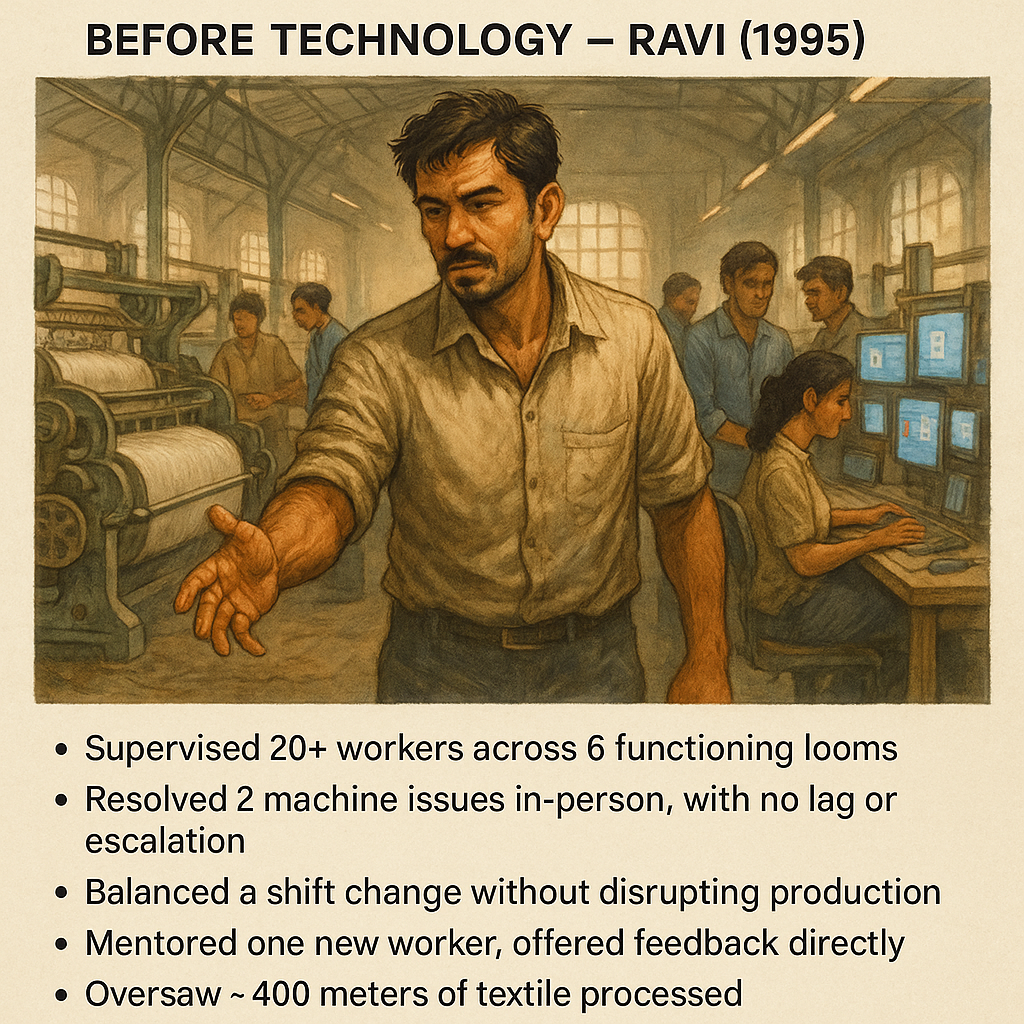
His work had clear start and end points. His contribution was visible and valued.
Section 2: After Technology – Priya (2023)
Priya logs into her dashboard at 8:45 AM with a cup of green tea and a sense of déjà vu—most days blur into each other now. She oversees logistics coordination for a regional hub, managing 6 fulfillment centers, 18 people across shifts, and a dozen software tools: Slack, Trello, Zoom, SAP, Google Sheets, a custom route optimizer, and a live order tracker.
By 9:30 AM, she’s already resolved a delivery queue backlog. Not directly, though—she pinged the tech team on Slack, filed a ticket, and added screenshots. While waiting for a reply, she joins a Zoom escalation call with warehouse leads. Everyone’s on mute. Cameras off. Her slide deck has KPIs. Her voice breaks slightly from overuse.
At 11:15, she gets a message: “Fixed, pls test.” She logs into the backend, runs two mock orders, confirms the flow works, and closes the loop with a checkmark. No one replies. She updates her daily tracker anyway.
By 2:00 PM, she’s attended three calls, coordinated a failed batch reroute via email, and had a quick 1:1 with a new warehouse lead—done remotely, voice only, between meetings.
She works through lunch, multitasking between a carrier pricing audit and drafting next month’s staffing forecast. She knows others are pushing their own limits too—there’s an unspoken pressure to keep up, stay sharp, outshine. Collaboration is polite, but competitive undercurrent runs through every project.
At 7:30 PM, she logs off—but continues watching WhatsApp group pings from team leads in case something “urgent” comes up.
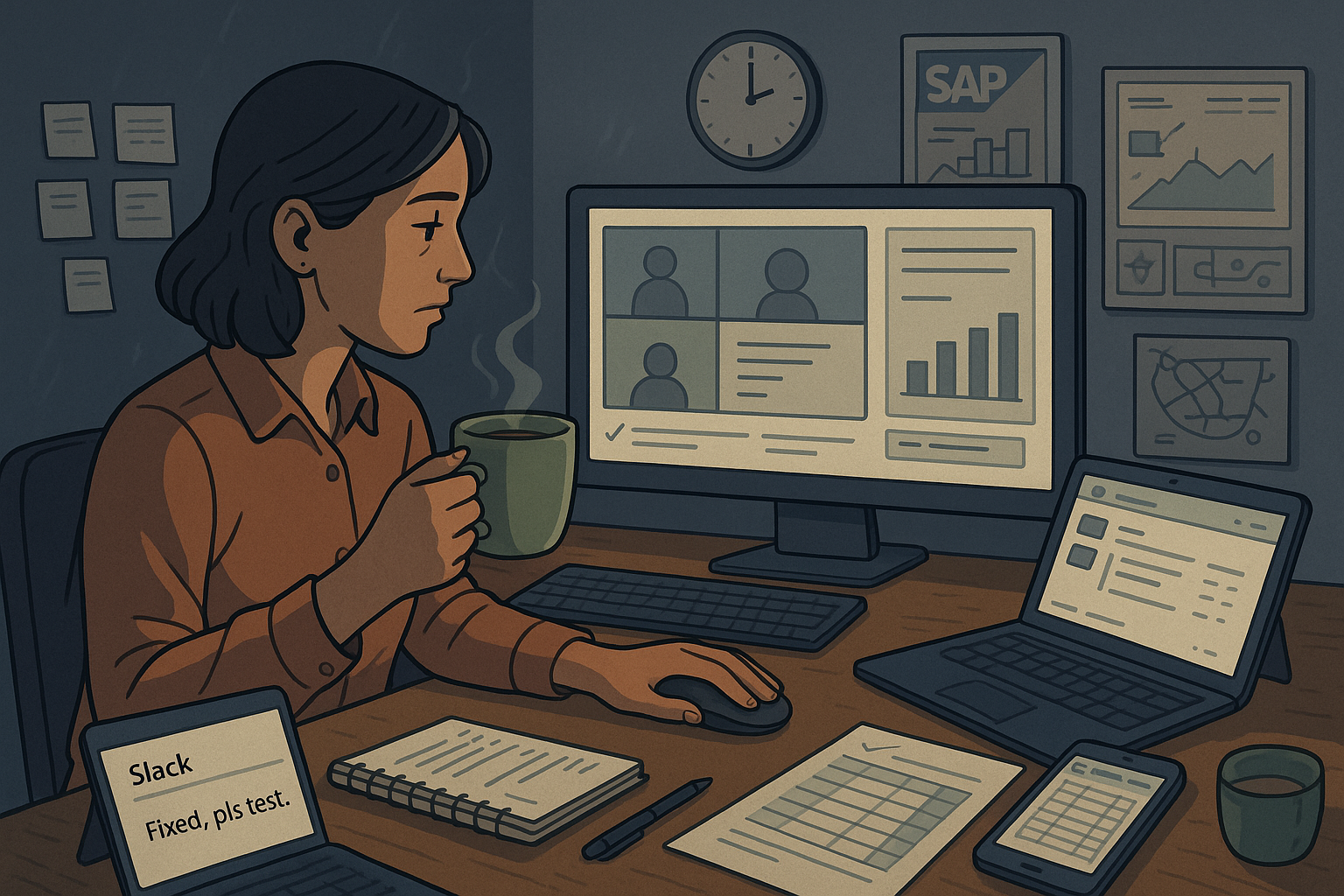
Her work volume was high—touching multiple systems and outputs. But her feedback was fragmented, her closure uncertain. Productivity soared. Clarity and satisfaction didn’t.
Yet, not all was lost. Compared to Ravi, Priya faced significantly less physical strain. Her posture, while tested by desk time, didn’t involve repetitive motion injuries. The air around her wasn’t filled with fabric dust. In terms of occupational health, her environment was arguably safer. She also had the flexibility to work from home, eat healthier, and attend a yoga class after hours if she chose to. Technology had created options—but hadn’t replaced human needs for feedback, purpose, and connection.
Section 3: The AI Future – Arun (2032)
Arun is 36, a “workflow integrator” at a decentralized consultancy that pairs human editors with AI content pipelines. His job? Prompt AI models, review deliverables, validate citations, and escalate nuance-heavy pieces to the “human review board.”
He logs in at 10:00 AM from a co-living pod in Pune. The AI has already processed three projects overnight—he’s expected to approve or revise them by noon. He does. It’s fast, efficient, and oddly hollow.
When he edits, Arun finds himself hesitating—not because the content is wrong, but because he no longer knows what his voice is supposed to be. In a world where 80% of draft work is machine-generated, human workers like Arun are no longer creators—they’re validators.
He doesn’t report to a manager; he reports to a dashboard. He’s part of a team, but they’ve never met. Even the “stand-ups” are AI-facilitated status checks. The competition isn’t just with peers anymore—it’s more systematized, more quantified, and more omnipresent. Ironically, in earlier eras, peer comparison was more transparent—based on what you could see or fix with your hands. Now, it’s wrapped in algorithms, weekly dashboards, and engagement metrics, stripping away nuance. Arun doesn’t just wonder if he’s doing well—he sees his name, rank, and percentile on a screen. It’s objective, but dehumanizing. The competition is with benchmarks, leaderboards, and the machine’s own accelerating pace. Everyone’s profile is monitored, scored, ranked—subtly, constantly. Arun’s day ends at 3:00 PM, but he doesn’t feel relief—just displacement.
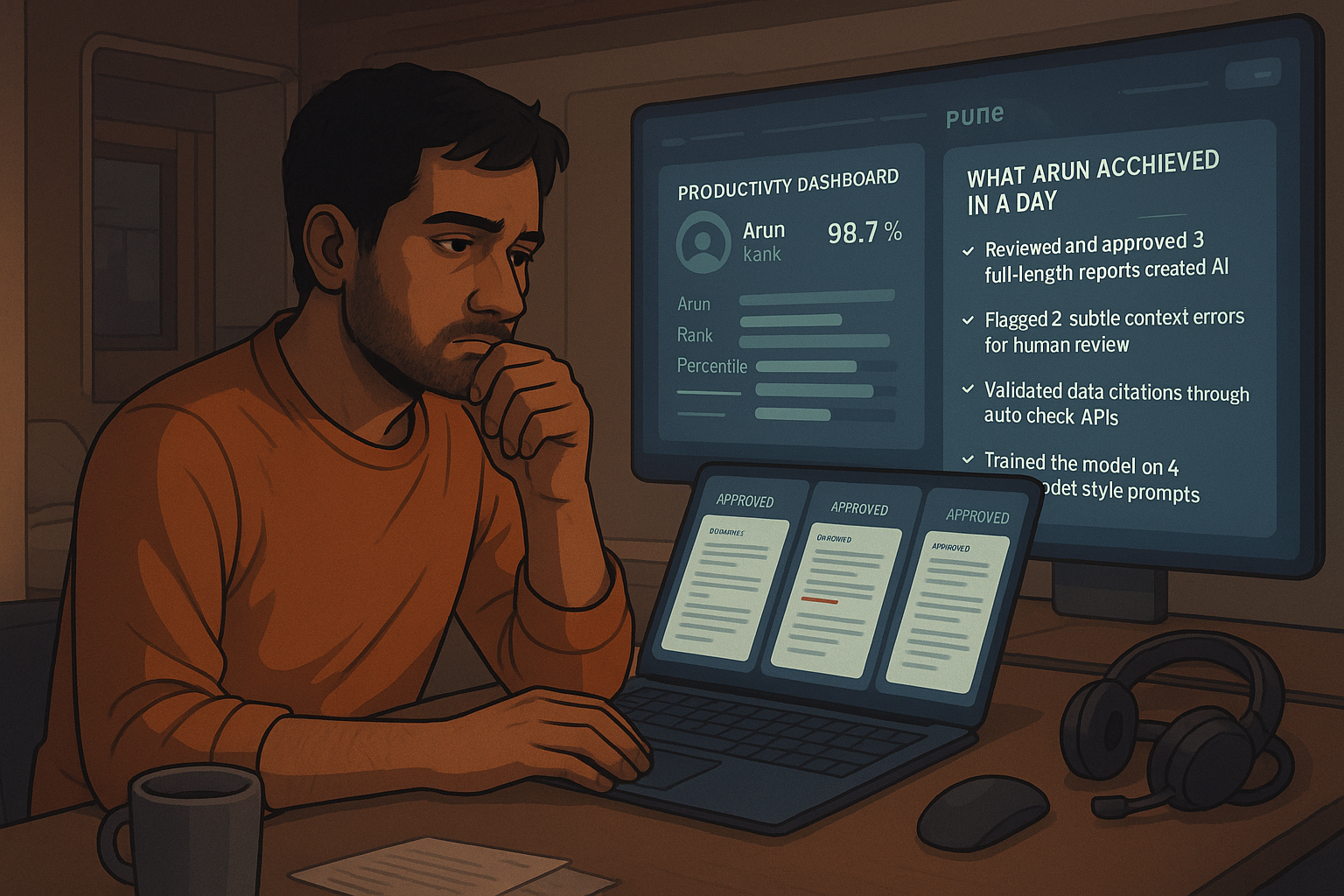
Arun did more than anyone in history could have—at lightning speed. His screen time was shorter, and his wrists didn’t ache. In theory, his work-life balance had never been better. But his fingerprints weren’t on anything. His day ended not with accomplishment, but with a question: “Does this even count as my work?”
Work Characteristics Comparison Table
| Era | Physical Effort | Mental Effort | Volume of Work | Human Connection | Job Security |
|---|---|---|---|---|---|
| Ravi (1995) | High | Medium | Medium | High | High |
| Priya (2023) | Low | High | High | Medium | Medium |
| Arun (2032) | Very Low | Medium | Very High | Low | Low |
Reflection: When Work Moves Faster Than Humans
The journey from Ravi to Priya to Arun isn’t just about changing jobs—it’s about how work itself has outpaced human adaptation. In just a few decades, work has gone from being visible and physical to intangible and cognitive to now, algorithmic and existential.
Each era brought gains: less physical strain, more flexibility, higher output. But those gains came with invisible costs. Ravi’s work was limited in volume but rich in ownership. Priya’s work exploded in complexity and coordination, but splintered her sense of closure and connection. Arun’s efficiency is unmatched—but his role raises questions about identity and purpose that productivity dashboards cannot answer.
Burnout today isn’t just about long hours or bad bosses. According to Gallup, McKinsey, and the APA, leading causes include:
- Lack of role clarity
- Fragmented human connection
- Absence of meaning or feedback
- Constant cognitive load
- Blurred work-life boundaries
In short: we changed work faster than we upgraded the human systems around it. Our minds and bodies evolved for friction, rhythm, and purpose—not Slack pings, AI validation, or 3-second attention loops.
The solution isn’t to reject technology—it’s to design human-first systems within it: systems that restore clarity, connection, and meaning. And central to that is helping people identify what they truly want to do—and what they’re naturally good at. In earlier eras, this discovery was often supported by in-person feedback, shared purpose, and visible results. But in today’s fragmented, tech-mediated workplaces, that clarity doesn’t emerge on its own.
Without human connection, mentorship, and real-time cues, people can go years without discovering if they’re on the right path. That’s not just inefficient—it’s dehumanizing. Meaning now requires more intentionality than ever before.
Another accelerating factor is the rise of internal competition—a subtle but constant pressure to outperform peers. In Ravi’s era, collaboration was built on trust and familiarity. Teams succeeded together, and respect was rooted in shared labor, not individual metrics. Today, however, many workers operate under unspoken scoreboards—performance dashboards, leaderboards, stack rankings—designed to extract more, faster.
This competitive environment erodes genuine connection. When your colleague is also your comparison point, trust thins. Praise feels political. Vulnerability becomes risky. True social connection only thrives where there is no fear of being outpaced. That space is disappearing. And with it, so is the psychological safety needed for belonging, creativity, and resilience.
Because burnout isn’t just about doing too much—it’s about losing yourself in the process.
