
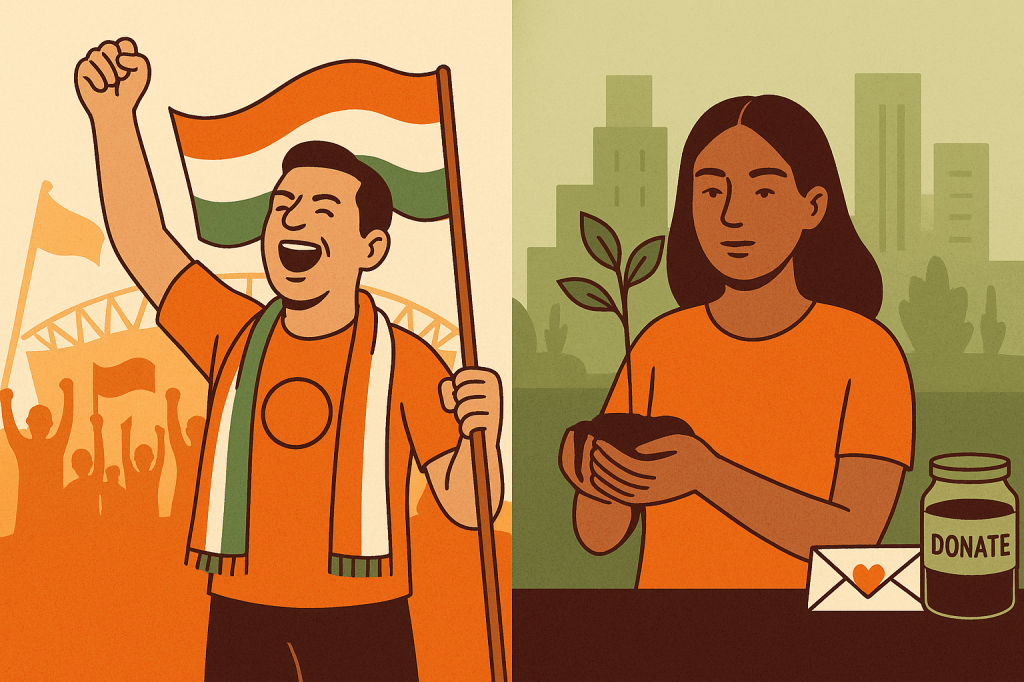
There are two kinds of patriots I’ve come to know.
One never misses a cricket match. He wears the jersey, paints his face, and defends the national team like it’s family. He talks about soldiers, shares viral videos of parades, and gets emotional when the national anthem plays before a game. His love for the nation is loud, proud, and contagious.
The other doesn’t say much. You won’t find him tweeting patriotic quotes or joining social media campaigns. But he pays taxes honestly, volunteers at a local school, and donates monthly to an NGO that helps disabled veterans. He sorts his waste, votes responsibly, and quietly builds what others only praise.
Both love their country. But they show it differently.
Symbolic Nationalism
Symbolic nationalism is about emotional expression. It manifests in:
- Cheering for the national team and taking pride in international sports victories
- Waving the flag on Independence Day and Republic Day
- Sharing patriotic songs, poems, or military achievements on social media
- Praising the military in speeches or viral posts
- Participating in cultural rituals that celebrate nationhood, such as singing the national anthem or dressing in traditional attire on national holidays
- Criticizing those who question the state, often branding them as ‘anti-national’
It often plays out in stadiums, schools, television ads, and increasingly on social media. For instance, during major cricket tournaments or national events, symbolic nationalism surges with hashtags, profile picture changes, and viral videos.
It is important. It binds people emotionally. It gives a sense of belonging, especially in times of crisis or celebration. In India and the U.S., symbolic nationalism often dominates public space and political discourse. But it is reactive—more a response to events than a consistent effort to improve the nation.
Functional Nationalism
Functional nationalism goes deeper. It is about serving the country through everyday actions:
- Paying taxes fairly and resisting the temptation to cut corners
- Supporting NGOs working on education, environment, or veteran care
- Volunteering time and effort to strengthen communities through civic engagement
- Demanding better governance through voting, public consultation, and accountability
- Living responsibly by following traffic rules, conserving energy, and reducing waste
Functional nationalism is reflected in the quiet but powerful contributions of everyday citizens—like a tech professional mentoring underprivileged students, a retired veteran leading a tree-planting or cleanup initiative, a homemaker organizing a recycling program in her locality, or a group of people crowdfunding for a child’s surgery or a village’s water tank. These acts may not make headlines, but they are the crux of true nation-building—steady, sincere, and selfless.
This form of nationalism is quiet. It doesn’t trend. But it creates ripples that gradually shape a better society.
It doesn’t need cameras or slogans. It needs commitment and consistency.
Both Are Valid, But Are They Equal?
Symbolic nationalism inspires. Functional nationalism builds.
One waves the flag. The other strengthens the pole.
Both are needed, but only one leads to real, measurable progress.
Can I Be Content With Just Symbolic Nationalism?
You can. But ask yourself:
- Will slogans clean a river?
- Will a social media post build a school?
- Will applause heal a wounded soldier?
Symbolic nationalism without functional nationalism is like loving your parents but never caring for them.
Functional nationalism doesn’t take sides. Its only allegiance is to what serves the nation best—regardless of politics, party lines, or noise. It is grounded in action, responsibility, and long-term vision.
Symbolic nationalism, on the other hand, often aligns with the loudest voices. It can become emotionally charged, polarizing, and susceptible to manipulation—especially in today’s social media world, where words spread faster than actions. In this noisy environment, clarity is hard to find.
Nationalism is ultimately about honesty and integrity—how genuinely you contribute to your country’s well-being. Ask yourself: does it feel good to pull down someone who speaks critically, or does it feel better to help improve the nation so much that critics are compelled to speak well of it? Does it feel good to post on Instagram about supporting the army (which should be a given, an obvious baseline of national pride)—or does it feel better to advocate for a higher defense budget and demand transparency in how that money is spent?
You tell me—which of these is more nationalistic?
It would not be too much to say that nationalism is not complete if you’re not implementing it. Merely feeling or performing nationalism is insufficient. In some moments, relying only on symbolic nationalism could even be counterproductive—fueling division, complacency, or misinformation.
So yes, watch the match. Cheer loud. Share your pride.
But when the anthem ends and the stadium lights go out, ask:
What did I do today to serve the country I love?
That’s the nationalism that endures. That’s the one that builds.
