
There are several troubling trends in this century: the widening gap between the rich and the poor, poor governance in third-world countries, money becoming the central theme of life, and now, AI is eating up jobs. It’s hard to ignore how much suffering has crept into our daily lives.
Movies are being made about the 9-to-5 job culture—claiming it’s so soul-crushing, it might just kill you. Poets are writing about social injustice. News channels rarely show anything positive. The younger generation is losing touch with the value of respecting elders. Look around, and it can seem like everything is getting worse.
Some people are trying to return to a simpler way of life—living like hunter-gatherers, becoming farmers, or just following their passions. In doing so, many are rejecting the very systems that, ironically, gave them the freedom to explore those choices.
A Simple Thing We Forget: Life Itself
In the midst of all this noise and negativity, we often forget one basic thing we should be grateful for: life.
We take longevity for granted. But just 150 years ago, the average global life expectancy was around 30 years. Today, it has more than doubled to over 72 years. That’s not magic—it’s medical science.
We now live in a world where many of the diseases that once haunted humanity have either been eradicated or drastically reduced, largely because of vaccines and medical breakthroughs. This is a quiet revolution. One that gave us time—not just to live, but to complain, reflect, dream, and grow.
5 Medical Miracles That Changed the Course of Human History
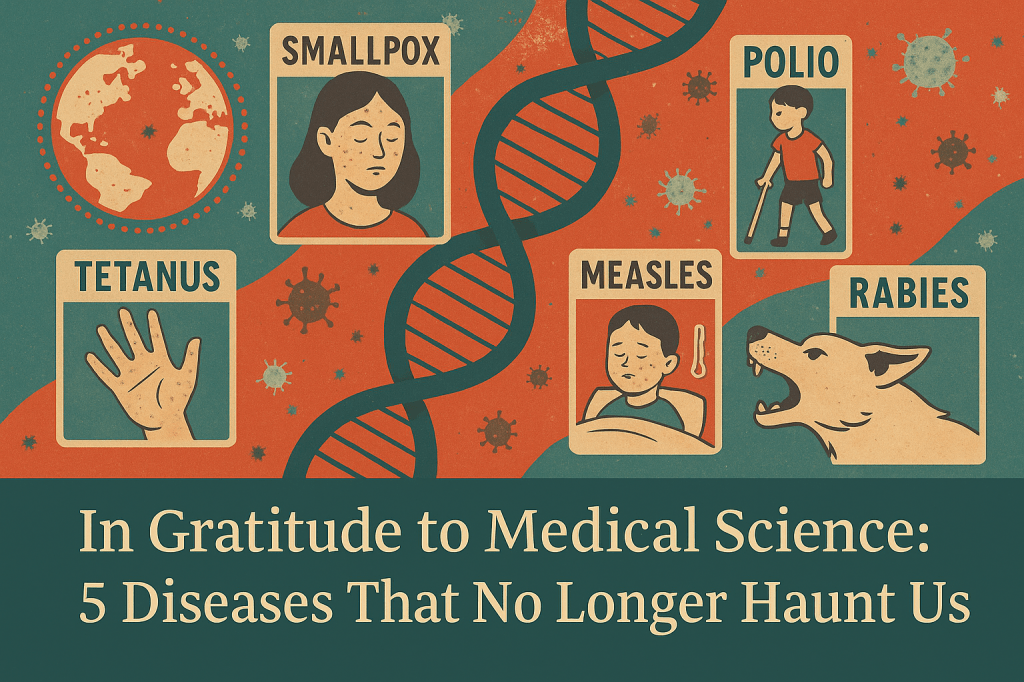
1. Smallpox: Erased from Earth 🌍
Smallpox was once one of the deadliest diseases known to humanity. Caused by the variola virus, it spread easily through the air and physical contact. Infected individuals experienced a high fever, fatigue, and a distinctive rash that evolved into painful, pus-filled blisters. Those who survived were often left with deep facial scars and, in some cases, blindness.
Historically, smallpox devastated civilizations—from ancient Egypt to the Americas. During the 18th century alone, it killed an estimated 400,000 people annually in Europe. It was also used as a biological weapon during colonial invasions.
Thanks to the world’s first vaccine discovered by Edward Jenner in 1796, and a global eradication campaign, smallpox was officially declared eradicated in 1980 by the World Health Organization. It’s the only human disease ever completely wiped out.
2. Polio: From Paralysis to Prevention 🦵
Polio was a nightmare for parents. It primarily struck children and spread through contaminated water or food. The virus targeted the nervous system, leading to muscle weakness, paralysis, and in the most severe cases, death from respiratory failure. Victims often required iron lungs—massive machines that helped them breathe when their lungs could not.
At its peak in the 1950s, polio outbreaks crippled over 350,000 people every year. Summer closures of swimming pools and theaters were common during outbreaks due to public fear.
The introduction of the oral polio vaccine in the 1960s changed everything. Today, thanks to global immunization efforts, cases have dropped by over 99%, and countries like India are now polio-free.
3. Tetanus: No Longer a Death Sentence 🔪
Tetanus is caused by a bacteria that thrives in soil, dust, and animal waste. It enters the body through wounds—sometimes as small as a pinprick. Once inside, it produces a deadly toxin that attacks the nervous system.
Symptoms begin with jaw stiffness—earning it the nickname “lockjaw”—and progress to painful muscle spasms, seizures, and difficulty breathing. In unvaccinated populations, the disease has a mortality rate of over 30%.
What makes tetanus especially terrifying is that it doesn’t spread from person to person. Every infection is a tragedy that could have been prevented. Thanks to routine vaccination, especially during childhood and after injuries, deaths from tetanus have become extremely rare in most parts of the world.
4. Measles: More Than a Childhood Rash 🌡️
Many think of measles as just a harmless rash, but before the vaccine, it was one of the leading causes of death among young children globally. The virus spreads through the air and is so contagious that a single case can infect up to 18 others.
Symptoms include high fever, cough, runny nose, red eyes, and a full-body rash. But the real danger lies in its complications: pneumonia, blindness, brain swelling (encephalitis), and long-term immune suppression that leaves children vulnerable for years.
In 2000, measles killed over 500,000 people worldwide. Since then, the MMR (measles, mumps, rubella) vaccine has led to an 80% drop in deaths.
5. Rabies: From Certain Death to Emergency Care 🐕
Rabies is one of the scariest diseases in human history. Caused by a virus transmitted through animal bites—most often dogs—it travels through nerves to the brain, causing a horrifying decline in the patient’s mental and physical state.
Early symptoms mimic the flu, but soon escalate to confusion, agitation, hallucinations, and hydrophobia—a paralyzing fear of water. Once symptoms appear, rabies is almost 100% fatal. Victims often die in extreme psychological torment.
Fortunately, post-exposure treatment—a fast-acting vaccine series administered after a bite—can stop the virus before it reaches the brain. Rabies deaths have dropped significantly in countries with strong vaccination programs and animal control.
Final Reflection: A Quiet Revolution Worth Remembering
These diseases once defined what it meant to live and die. Today, they are largely preventable or gone. That’s not luck. That’s progress.
Being born in this age of medicine is a privilege. It’s time we remembered that.
Gratitude isn’t ignoring what’s wrong. It’s remembering what’s right.

One response to “In Gratitude to Medical Science: 5 Diseases That No Longer Haunt Us”
[…] choices. Our societies have progressed in remarkable ways. In a previous blog, I reflected on how medical science has helped us overcome deadly diseases like smallpox, tuberculosis, and polio — achievements that would have sounded like miracles just […]
LikeLike