

Let me start with a disclaimer: you don’t have to make an either/or choice between comfort and purpose.
Most of us want a life that is both comfortable and meaningful. But the truth is — very few actually manage to build a life that has both.
The Early Chase for Comfort
At an early age, life is rarely about purpose. And that’s okay.
As human beings, our natural instinct is to secure a comfortable life — for ourselves and our families. That becomes the priority. Our education system is designed to support this goal: we study external subjects, become skilled, and try to build a career that ensures stability. It’s a defined process — not guaranteed, but statistically, it gives us a better chance at comfort than any undefined alternative.
Purpose, on the other hand, doesn’t usually come into focus until much later. For some people, it never does — and that’s also fine. What you don’t know, doesn’t affect you.
But most of us, sooner or later, arrive at a crossroads — where we understand the difference between comfort and purpose, and realize we may have to choose between them.
The Comfort Illusion
Comfort has no upper limit, but it definitely has a lower one. Once we reach a basic level of comfort, we don’t stop. We keep accumulating — not just more comfort, but also more discomfort to maintain or upgrade it.
Ten years ago, your definition of “bare minimum” was probably very different. Today, that baseline has quietly shifted. We tend to believe we’re working for more comfort — but often, we’re just raising our expectations.
Are we ever going to attain a “perfectly comfortable” life?
Most likely, no.
Then why not, at some point, start channeling some of that effort toward purpose?
Defining Purpose
Purpose is one of the most subjective words in human language.
At its core, purpose means living with a reason — one so important that everything else becomes secondary. When that reason is fulfilled, it brings peace. Everything else becomes a bonus.
But choosing a purpose doesn’t come easy. Many people confuse it with current responsibilities or retrofit it to justify their lifestyle. Real purpose, however, goes beyond the self. It’s about living with intention — often selflessly — and helping others build a better life.
Some might ask: Why go through the trouble of finding a purpose when I’m already given a life template to follow?
Because that template wasn’t designed for you. You have the right — and the responsibility — to create one that actually fits you. It is liberating to learn more about yourself and live truthfully. Purpose shapes how you make decisions, what you prioritize, and how you experience fulfillment.
If your purpose is simply to breathe, then you’re already living in peace. If your purpose is to spread happiness, you’ll naturally prioritize others’ well-being and filter out negativity.
Design your life around your purpose — not the other way around.
You Don’t Need to Sacrifice One for the Other
You don’t have to give up comfort to live with purpose. That would be counterproductive. In fact, you need a certain level of comfort — stability, peace, resources — to even begin the pursuit of purpose.
The real key is this: don’t endlessly raise your minimum standard of comfort.
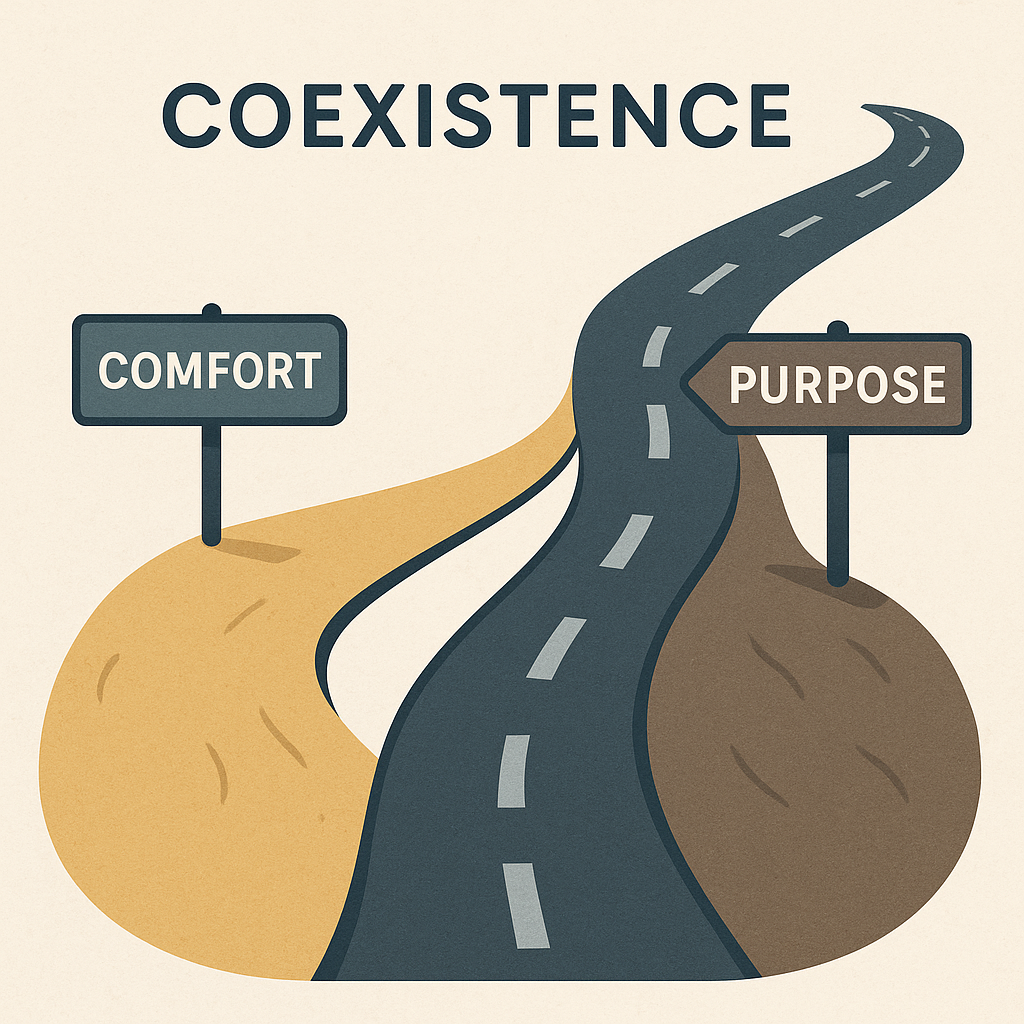
At some point, define what’s “enough.” Once you’ve secured that, shift your attention. Don’t let the pursuit of more comfort distract you from discovering what makes your life meaningful.
Purpose doesn’t always arrive early. Sometimes it takes a lifetime. But once you find it, your life will transform — becoming lighter, more peaceful, and more giving.
You won’t need another car to feel happy.
You won’t need to win every deal.
You won’t need to live just for yourself.
Purpose gives you liberation. Comfort enables you to find purpose.
They coexist — they are not mutually exclusive.
