
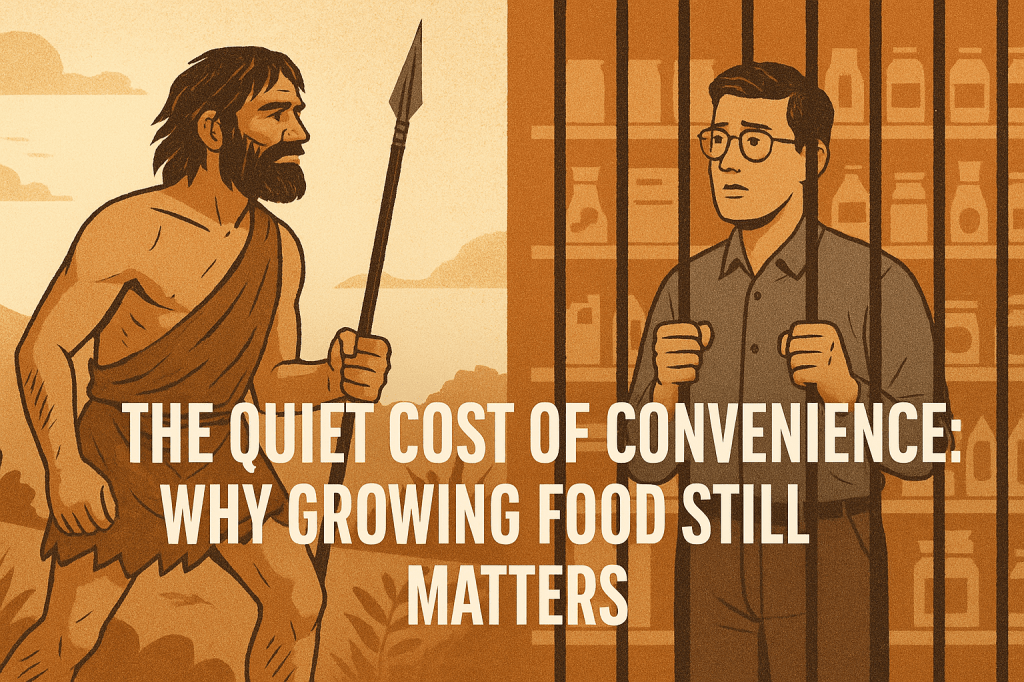
For hundreds of thousands of years, human life revolved around one fundamental activity: finding food. Every waking hour was spent hunting, foraging, preserving, and migrating in search of nourishment. Our biology evolved for it. Our stories were built around it. Our very survival depended on it.
Then, roughly 13,000 years ago, something revolutionary happened—we discovered agriculture.
We domesticated food.
No more chasing wild herds. No more nomadic life. For the first time, humans could grow what they needed, where they lived. It changed everything—culture, community, even civilization itself.
Fast forward to 2025, and less than 4% of the global population is involved in growing their own food. In developed nations, that number drops below 2%. The rest of us rely almost entirely on complex supply chains, industrial agriculture, and supermarket shelves.
The average person today spends less than 1% of their time growing, researching, or even thinking about what they eat. We consume food on autopilot—produced by people we’ll never meet, made with ingredients we barely recognize.
In a blink of evolutionary time, we’ve shifted from full-time food seekers to passive consumers.
How did this transformation happen?
Was it progress?
Was it detachment?
Or was it simply the quiet cost of convenience?
When We Lost the Skill, We Lost Something More
We’ve become detached from one of life’s most fundamental cycles: growing our own food. Food isn’t just fuel—it’s survival, connection, and culture. But somewhere along the way, we outsourced that responsibility. We handed it over to industries, systems, and apps.
And in doing so, we didn’t just lose a skill.
We surrendered a kind of freedom.
When you no longer know how to nourish yourself, you lose a piece of autonomy—physically, mentally, even spiritually. That dependence seeps into how we think, how we move, and how we relate to the world.
When the System Cracked
During the COVID-19 pandemic, the illusion of convenience broke.
Grocery shelves emptied. Delivery apps couldn’t keep up. In countries like the U.S., where labor is expensive, food delivery came with surcharges—and risk. Behind every grocery bag was a delivery worker exposing themselves so others could eat.
In that moment, people realized how fragile the system really was.
But there was one group that didn’t panic: the 4% who grew their own food. While the world scrambled, they harvested. While others were stuck indoors, they stepped into their backyards.
They weren’t just gardening—they were living independently.
The system failed.
They didn’t.
Why Growing Food Still Matters
Pandemics, climate change, inflation—these aren’t distant threats. They’re symptoms of a fragile system. And those who depend on it without alternatives are the first to suffer.
That’s why growing food is more than just practical.
It’s essential.
Because once you start growing even a little bit of food, you begin to learn:
- How to collect rainwater
- How to compost waste
- How to reuse, recycle, and live in sync with nature
- How to listen—to the soil, the sun, the season
You begin to respect the earth.
You begin to understand climate change—not through headlines, but through experience.
And when you’re eating what you grow, you stop poisoning the soil with chemicals.
Growing food becomes a form of climate action.
A form of education.
Even a spiritual journey.
A Small Action Is Still an Action
Of course, we live busy lives. A 9-to-5 job doesn’t leave room to grow 100% of your food—and that’s okay.
But you can still:
- Learn how food is grown
- Visit a farm or farmer’s market
- Eat seasonal and local produce
- Know your farmer, not just your grocer
- Involve your kids in gardening
- Stay connected to trees and the land around you
You don’t have to make food your full-time job.
But you can make it your weekend hobby.
Make the food lifecycle a part of how you live, how you parent, how you learn.
Because food isn’t just what we eat.
It’s how we survive.
It’s how we grow.
It’s how we stay free.
