
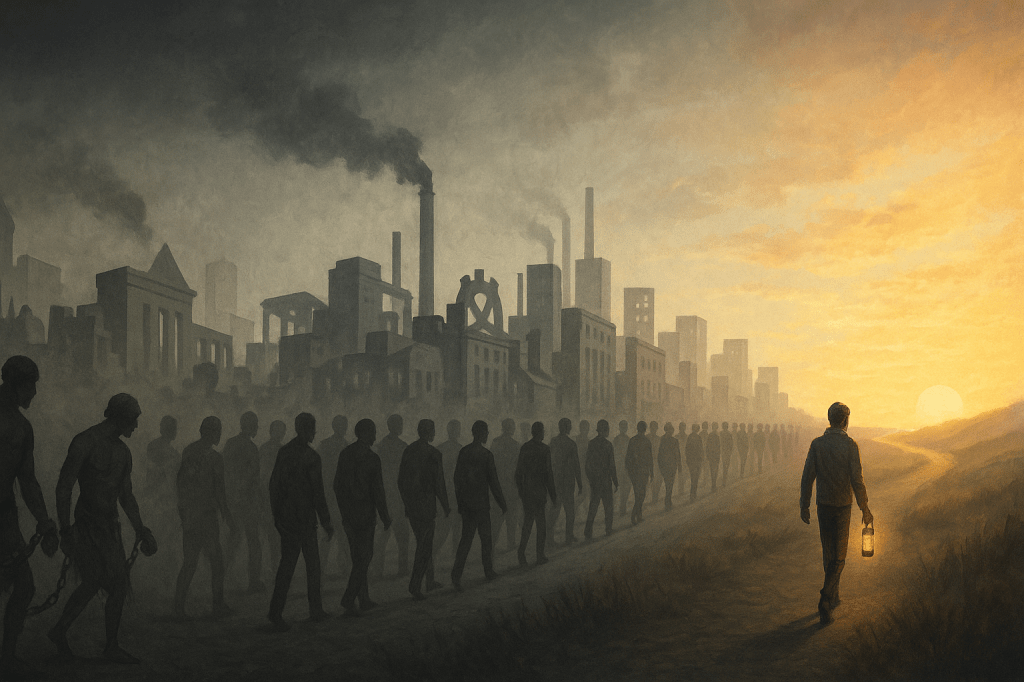
Every generation believes it is making the right choices. Ours is built around work — the structure that gives meaning, identity, and survival. But what if this, too, is the illusion of our time?
For centuries across much of the world, slavery was an accepted system where human beings were treated as property — bought, sold, and forced to work without freedom or compensation. It existed not just in America, but in Africa, Asia, the Middle East, and Europe in different forms. People were captured or born into servitude, their lives entirely controlled by others. What shocks us today is that it lasted for hundreds of years — not because people didn’t see suffering, but because society was built around it. It was seen as “normal,” even moral, justified by religion, economy, and custom. Only much later did humanity collectively realize the enormity of that wrong — that no progress or profit could ever justify ownership of another human life.
And yet, this history leaves behind an unsettling question: if something so cruel could feel normal for so long, what might we be normalizing today without realizing it? We may no longer be chained, but perhaps our dependence has only changed form. Modern employment, though far more humane, might still carry echoes of that same structure — where people surrender most of their time and energy to systems they did not create, serving goals they did not choose, all in the name of survival and order.
In A People’s History of the United States, Howard Zinn describes how millions of Africans were taken from their lands, families, and communities, and shipped across oceans into a world where they had no roots, no networks, no shared identity. Disconnected from everything familiar, they were easy to control — socially, emotionally, and economically. Dependence was not just physical; it was psychological.
In a quieter, more civilized way, something similar may be happening today. Many of us are detached from our communities, our land, and even from the skills that once made humans self-reliant. We depend entirely on jobs and institutions for survival — for food, healthcare, housing, and meaning. The more we rely on these systems, the harder it becomes to imagine life outside them. Just as separation made slaves dependent on masters, modern isolation may have made workers dependent on employment. Freedom exists in theory, yet most cannot afford to use it.
It is easy to believe that we are making the right choices, that our systems are fair and our lives self-directed. But history teaches a humbling lesson: every generation thinks it is free until time proves otherwise. If history is any proof — from slavery to servitude to modern management — systems will always find ways to make people work for them, for without it, they cannot profit. It is up to us to recognize whether we are falling into a similar pattern of dependence, dressed in a more acceptable form.
The example of work and employment is just one reflection of this broader truth — that it takes decades, sometimes centuries, for societies to self-correct. We cannot rely on time alone to expose what is wrong; awareness must come from within us. The only safeguard is to continuously question our choices, learn from history, and stay open to change. Humans are not perfect — and perhaps never will be — but we can choose to be less blind. Make decisions as objectively and independently as possible. Don’t fear big changes; they are often the first sign that growth is happening.
Perhaps the real question is not whether we are free, but whether we have the courage to see what binds us — and the honesty to change when we do.
