
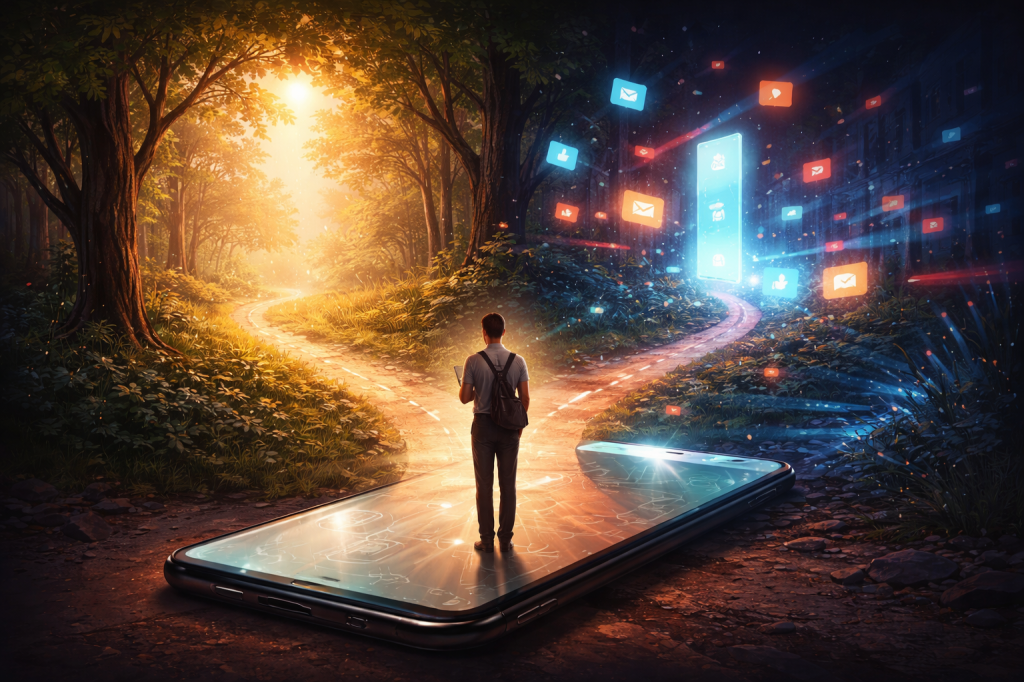
Technology rarely changes our behavior through force or persuasion. It changes it by quietly redefining what feels normal.
Most of us did not consciously decide to check our phones dozens of times a day. We never formally agreed to instant replies, constant availability, or fragmented attention. These behaviors emerged gradually, not because we chose them, but because technology replaced deliberate choices with defaults.
Understanding this shift — from choice to default — explains a lot about modern life.
Technology changes behavior by replacing conscious choice with defaults.
Earlier, everyday actions required effort. You had to remember, plan, and commit. That friction acted as a filter. Technology removed it. One-click buying, infinite scroll, and external memory made action effortless.
When effort disappears, behavior becomes automatic. Defaults take over and, over time, convenience turns into expectation.
This shift shows up first in attention. Interruptions are no longer external; they are internal. Notifications train anticipation. The brain learns to check even when there is no reason to. What feels like distraction is often habit running on autopilot.
Cheap exits also change decisions. When reversing choices is easy, commitment weakens. Streaming replaces watching. Browsing replaces choosing. Speed is rewarded more than depth.
The same pattern applies to work. Better tools didn’t reduce work; they raised expectations. Faster communication compressed response times and expanded what is considered normal output.
Over time, these defaults harden into social norms. Being offline feels irresponsible. Delayed replies feel rude. Availability is mistaken for professionalism.
Every system strengthens some skills and weakens others. We get better at switching and scanning, and worse at waiting and sustained focus. This is not a moral failure. It is a trade-off.
So What?
This matters because many people blame themselves for things that are not entirely personal.
When focus drops, it feels like a lack of discipline. When energy runs low, it feels like incompetence. When life feels overwhelming, it feels like poor self-control.
But a large part of this discomfort comes from living inside systems built for speed, efficiency, and constant output — not for human limits.
A content life has always been about depth, not speed. About staying with things long enough to feel them fully — a conversation, a piece of work, a day, a phase of life. Speed makes systems efficient, but depth is what makes life feel complete.
Technology optimizes systems. Humans live inside them.
Understanding this does not mean rejecting technology. It means noticing when speed is rewarded at the cost of depth. Once those trade-offs are visible, people regain some choice. And even a small amount of choice shifts life away from constant pressure and back toward quiet contentment.
