
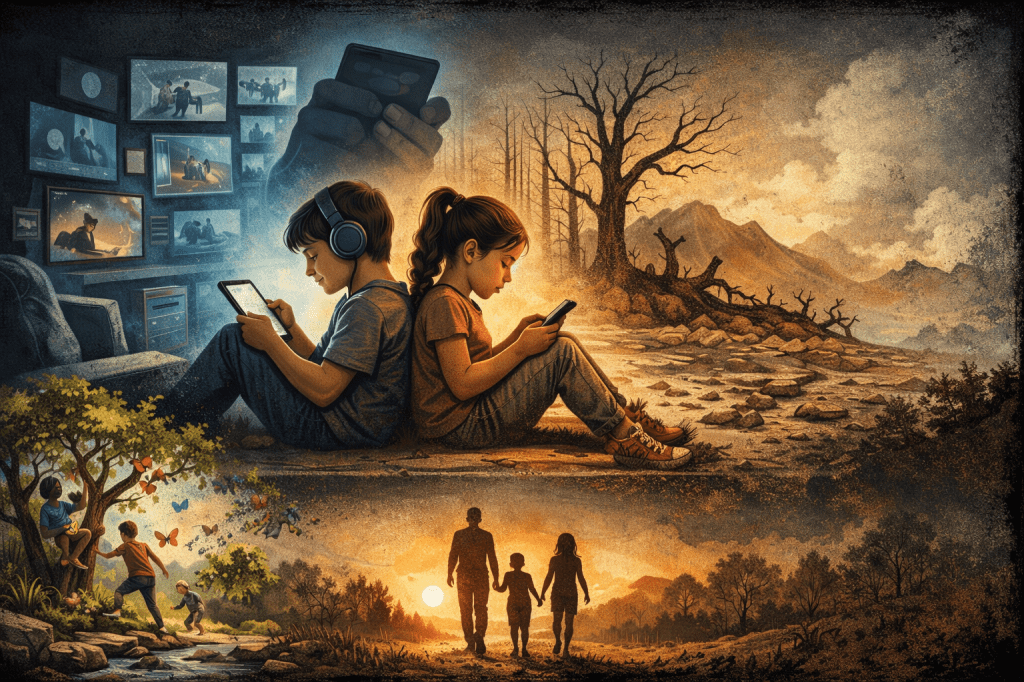
I recently watched two 10-year-old kids sitting together in a room. They were physically close, yet completely disconnected—both on their own devices. No conversation. No play. No curiosity about each other’s presence. What worried me was not just the silence, but how normal it seemed to them. I had to enter the room deliberately to create a distraction. I sat with them, spoke to them, and had to invent simple physical games just to get them to move and play. Once guided, they responded well. They laughed, moved, and were present—but it required immense effort: suggesting games, setting rules, nudging them away from screen-conditioned comfort. The moment I left the room and supervision disappeared, they went straight back to their devices. That moment stayed with me. This is not an anti-technology rant. This is a warning.
The biggest enemy of child growth today is unchecked digital content consumption. Unlike junk food, it doesn’t look harmful. It looks quiet. Convenient. Educational. Safe. And that’s precisely why it slips past us.
When consumed without boundaries, screens do not make children smarter; they make them passive. A child endlessly consuming digital content is not learning faster—they are outsourcing thinking. Algorithms deliver answers before questions are even formed, and curiosity, which needs friction and effort, slowly fades away. Physical intelligence takes the first hit. Running, climbing, falling, balancing—this is how a child’s brain wires itself to the body. A child who grows up sitting grows up thinking slower, reacting slower, and fearing physical discomfort. Screens flatten curiosity and numb cognitive effort. Fast cuts, instant rewards, and constant stimulation condition the brain to expect effort-free engagement. Real thinking starts to feel boring. Silence feels uncomfortable.
Nature, meanwhile, quietly disappears from their life.
Schools, unfortunately, are becoming active participants in this shift. Many now provide assignments exclusively in digital format. Homework arrives through apps, portals, or messaging groups, forcing children to check phones, tablets, or laptops—not by choice, but by design. As a parent, you may want to limit screen exposure and take a photocopy of the assignment so your child can work offline, but the system pushes back. Logins are required, submissions are digital, and notifications keep pulling the child back to the screen. What schools often fail to see is this: once a child is on a device, control is already lost. An assignment tab sits next to games, videos, messages, and endless distractions. The intention may be education, but the side effect is addiction training.
This should deeply worry us. We are raising children in a time of climate instability—water stress, heat waves, food insecurity—yet many kids today have no emotional connection to nature. No soil on their hands. No trees they care about. No seasons they notice. People do not protect what they do not feel connected to. A generation disconnected from nature will not fight for it; they will scroll past it.
The modern world is also unapologetically capitalist. Attention is the most valuable currency. Your child is not the customer. Your child is the product. Every extra hour on a screen trains consumption, weakens patience, normalizes constant stimulation, and reduces tolerance for effort and boredom.
No corporation will ever prioritize your child’s character over engagement metrics. That responsibility now lies entirely with parents.
Formal education itself is entering uncertain territory. In an AI-driven world, no one knows which jobs will survive or which degrees will remain relevant. Syllabi will change and institutions will adapt slowly. But some things will always matter—empathy, emotional intelligence, the ability to focus, independent thinking, and a connection to people and the real world. These are not taught by screens; they are absorbed through living.
Parenting has fundamentally changed. Earlier generations could rely on schools, communities, outdoor play, and slower lives. Doing nothing wrong was often enough. That is no longer true.
Today, intentional effort is required—not better apps, not smarter devices, not more educational content, but boredom, nature, unstructured play, physical effort, and real conversations.
If a child grows up entertained all the time, they grow up unable to create. If they grow up protected from discomfort, they grow up afraid of reality. If they grow up disconnected from nature, they grow up indifferent to its destruction.
This is not about banning technology. It is about not letting technology replace childhood.
Because once childhood is gone, no algorithm can bring it back.
