
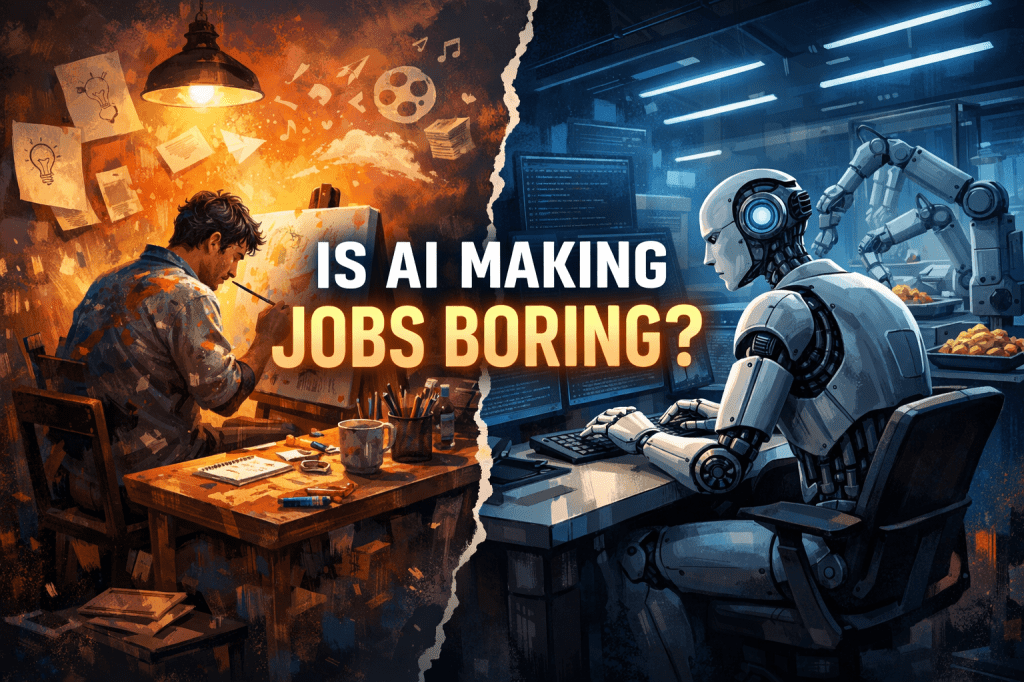
Humans thrive on creativity. The more creative a task is, the more meaningful it feels. Creativity is not limited to painting masterpieces or writing novels. It lives in small daily acts — chopping vegetables, cooking a meal, handwriting a letter, solving a problem, telling a story. For centuries, creativity has been woven into our survival and our fulfillment. The question now is whether artificial intelligence will weaken that thread — or transform it.
Automation Has Always Shifted Creativity
Over the past few decades, automation has replaced many tasks. Handwriting — once a fundamental part of growing up — has faded. Writing letters is no longer necessary. Vegetable chopping has been replaced by machines. Many repetitive manual processes have disappeared. Yet humanity adapted. Instead of focusing on handwriting, we focused more on content. Instead of spending time chopping vegetables, we focused on recipes. Digital automation gave rise to entirely new forms of creativity: computer programming, content writing, filmmaking, and modern storytelling through films and television. History suggests a pattern: when one form of creativity disappears, another emerges.
Why AI Feels Different
Artificial intelligence introduces a shift unlike previous waves of automation. Earlier automation replaced parts of a process. AI has the potential to replace the entire process. A machine that chops vegetables still requires a human to cook. But an AI system can generate the recipe, design the dish, write the menu, and even optimize the presentation. Think of a teacher. Teaching is deeply creative — adapting explanations, reading emotional cues, improvising examples. That creativity works because children are learning about the world for the first time. But with machines, the dynamic changes. Machines already “know” vast amounts of information. The teacher is no longer shaping curiosity — only guiding output. The creative interaction narrows. This is what makes AI distinct: it does not just assist effort. It can replace cognitive participation.
The Psychological Risk
Creativity is not just economic value — it is psychological fuel. We feel fulfilled when we struggle, attempt, refine, and finally produce something of our own. AI increases productivity in writing, coding, designing, and problem-solving. But productivity and fulfillment are not the same. When friction disappears, so does a certain kind of satisfaction. If too much of our creative input is outsourced, the risk is not unemployment — it is complacency. Complacency can lead to boredom. Boredom can erode our innate need for meaning. Just as GPS reduced our sense of direction and spatial memory, AI may reduce our creative endurance if we are not careful.
Is Prompting the New Creativity?
Some argue that writing prompts is itself creative. The output depends on how thoughtfully the prompt is crafted. There is truth in that. Prompt engineering requires imagination, clarity, and experimentation. But it differs from creating something entirely from scratch. The outcome becomes a collaboration between human and machine. Ownership becomes shared. Originality becomes layered. The question is not whether prompting is creative. The question is whether it satisfies the same psychological need as building something slowly, imperfectly, and entirely by oneself.
The Responsibility Ahead
It is difficult to predict the long-term impact of AI. History suggests humanity adapts. But history also shows that adaptation is not automatic — it is intentional. If creativity is essential for fulfillment, then we must consciously protect it. That may mean doubling down on creative chores today — cooking, writing, building, learning, experimenting — even when tools make them effortless. It means encouraging children to draw, write stories, ask questions, and build things — not just generate answers. AI should remain an assistive tool, not a substitute for effort. The danger is not that AI will replace our work. The danger is that it may replace our need to try. And if we lose the need to try, we may lose more than productivity — we may lose a piece of what makes us human.
