
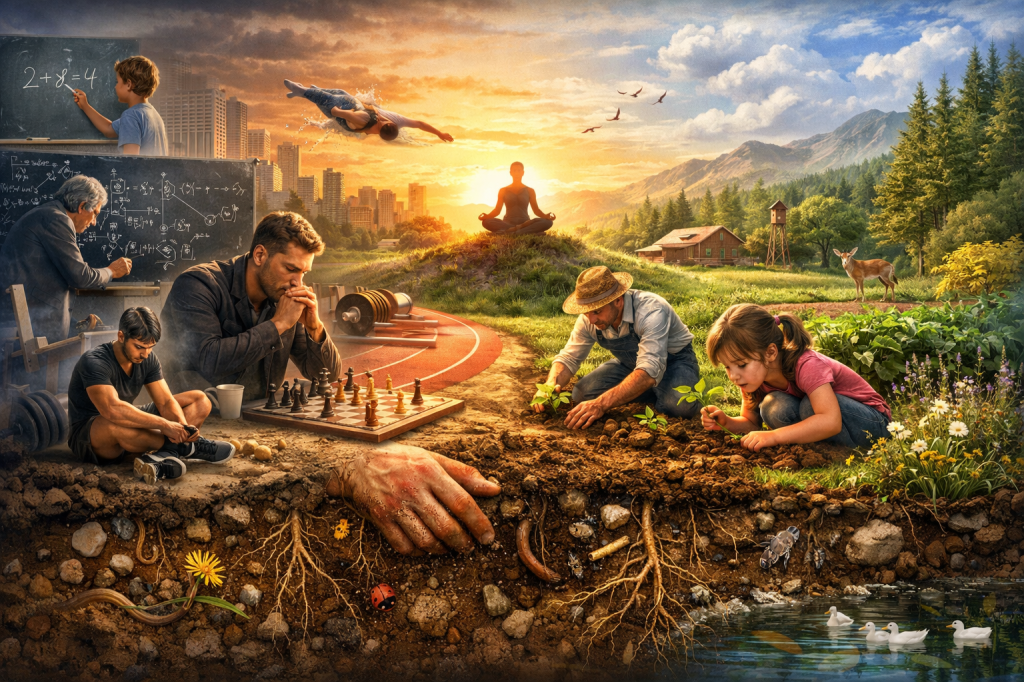
In almost every domain of life, we instinctively return to the source.
In academics, Math and Physics are considered fundamental. That is why we teach them early. Not because every child will become a scientist — but because without understanding 2+2=4, complex problems remain inaccessible. The source isn’t studied for a guaranteed outcome. It is studied because people somehow know: this cannot be bad.
The same logic applies everywhere. A singer takes care of their throat, avoids food that strains the voice, and practices basic notes daily — even if they perform a completely different genre. The source keeps them grounded. For a sportsperson, it is physical fitness. For a chess player, mental endurance. For a swimmer, high-intensity conditioning. For a mechanical engineer, it is physics. In each case, the most accomplished people maintain their connection to the source — not obsessing over results, but trusting that the foundation holds.
This idea goes beyond skills. Meditation has gained so much attention because it works at the source of emotions. Once you see where a feeling originates, you stop reacting to it blindly. There is no more unknown to fear.
So here is the question that lingers:
If we value the source so deeply — in education, in craft, in mental health — why do we remain disconnected from the source of our physical existence?
That source is soil.
Every living being returns to it eventually. Some faster, some slower — but it happens. Soil is not a metaphor. It is the literal origin of the food that builds us, the ground that holds us, the matter we will one day become.
The more I have tried to understand farming, the more convinced I have become that there is no better mirror for understanding oneself. Learning the difference between good soil and bad soil. Understanding why chemicals kill the soil — and why so many people today are running campaigns not to improve food yield, but to improve the soil itself. They know that fixing the soil fixes everything — the food, the life beneath the ground, the underground water, the entire ecosystem. Working on soil, I have come to feel, is like working on the self. It is perhaps the most spiritual experience available to us.
And here is what surprised me most: the science has already caught up to this intuition.
In 2007, researchers from Bristol University and University College London discovered that a common soil bacterium — Mycobacterium vaccae — activates brain cells to produce serotonin in a way that closely mirrors the effect of antidepressants. Not through pills. Through simple contact. Inhaling it. Touching soil that contains it. Dr. Chris Lowry, who led the research and has spent nearly two decades on it since at the University of Colorado Boulder, put it plainly: perhaps we should all be spending more time playing in the dirt. His later work found that people who grow up in rural environments, in regular contact with soil, are measurably more resilient to stress — and he is now researching whether soil bacteria could help treat PTSD in military veterans.
A study called Play and Grow, conducted with preschool children in Hong Kong, found that regular exposure to soil and outdoor nature stabilised gut serotonin levels and measurably reduced anger and stress — compared to children without such exposure. The researchers noted something quietly radical: simply telling children it was acceptable to get their hands dirty was itself enough to begin shifting outcomes.
The relationship between soil and the human body, it turns out, is not metaphorical. It is biochemical.
And yet we have drifted far from it.
We replaced forests with concrete. We stopped building homes from natural materials and moved to processed ones. Outdoor spaces, even those designed for sport and play, are increasingly artificial — rubber tracks, synthetic turf, padded surfaces — engineered precisely so that no one gets dirty. The word “dirty” itself became something to avoid. And then came social media, pulling attention indoors and downward, onto screens. Each of these shifts, small on its own, has collectively severed a connection that took millions of years to form.
What if we applied the same principle here that we apply everywhere else? We do not always know in advance what benefit we will get from learning about the source — yet we still pursue it. The child studying Math does not know exactly how it will serve them. But we trust it will. Why not extend the same trust to soil?
You do not need to study it academically. You do not need to understand it fully. You just have to stay connected — in some form.
Go for a walk in nature. Let children play in soil. Encourage them to observe the biodiversity that lives in healthy ground. Help them understand its relationship with climate. Grow something. Get your hands dirty. Do not be afraid of it.
The thought that soil can affect your sense of fulfillment may sound philosophical. But it is actually fundamental — in the same way that practicing basic notes improves a singer’s performance without them always understanding why. The connection works whether or not you can explain it.
I believe there will come a point when each of us will see a direct relationship between our connection to soil and the quality of our inner life. Not as a theory — but as something lived and felt.
Stay connected to the source. It cannot be bad.

One response to “Soil is the Source”
We trust the source in everything except soil. Yet it feeds us, holds us, and even heals us. Get your hands dirty
LikeLiked by 1 person