
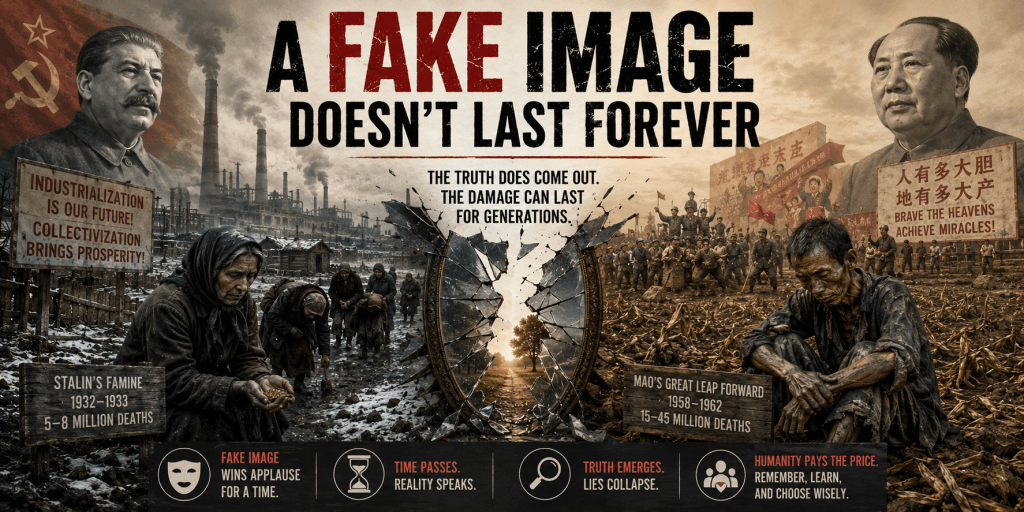
Stalin’s Famine (1932–1933): Under Joseph Stalin, the Soviet Union forced farmers into collective farms and seized grain to fund industrial growth, but the policy backfired as agricultural output fell and millions were left without food. Instead of acknowledging failure, the state continued taking grain—even exporting it—while suppressing reports of famine and restricting movement so starving people could not leave affected regions. The famine itself lasted roughly 2 years (1932–1933), but its impact was felt for much longer, as agriculture remained weakened and rural populations struggled through the mid-1930s, with lasting damage to farming systems and communities. In total, an estimated 5–8 million people died, including millions in Ukraine.
Mao’s Great Leap Forward (1958–1962): During the Great Leap Forward led by Mao Zedong, China attempted rapid industrialization by reorganizing rural life into communes and diverting farmers toward industrial activities, while enforcing flawed agricultural practices. Local officials, fearing punishment, exaggerated production numbers, leading the state to extract more grain than was actually available. The famine unfolded over about 3–4 years (1959–1962), but its effects lingered well beyond that, with economic and agricultural recovery taking until the mid-1960s. The result was the deadliest famine in human history, with an estimated 15–45 million deaths, showing how misinformation, fear, and rigid policy can extend suffering far beyond the initial crisis.
At an individual level, it is true that lies do not last forever. The truth does come out—but the timeline differs. For nations and large systems, it can take decades or even centuries, often beyond our lifetimes, which is why we don’t always see clear consequences immediately. But at an individual level, the feedback loop is much shorter. You can observe it in your own life or in people around you. There is often a subtle insecurity beneath a false image—a constant fear of being exposed. These examples show how entire nations can suffer when decisions are driven by ego instead of reality. In both cases, leaders were trying to prove something—to the world and to themselves—that their system was superior. In that pursuit, they ignored ground truth and paid the price in human lives. While national policies are complex and easier to judge in hindsight, individual choices are much simpler. We often don’t know exactly what we want, but history teaches us one thing: don’t live by comparison. Understand your own limits, constraints, and strengths, and make decisions that are true to you. One path does not fit everyone. When in doubt, choose what is right, even if the results are unclear in the moment. In the long run, truth compounds. Many people spend their lives building an image, only to realize it was never truly theirs. All this time, they were chasing someone else’s dream. No matter how small the step, if we try to live authentically, we rarely go wrong. A false image, whether for a person or a nation, cannot sustain itself for long.
