
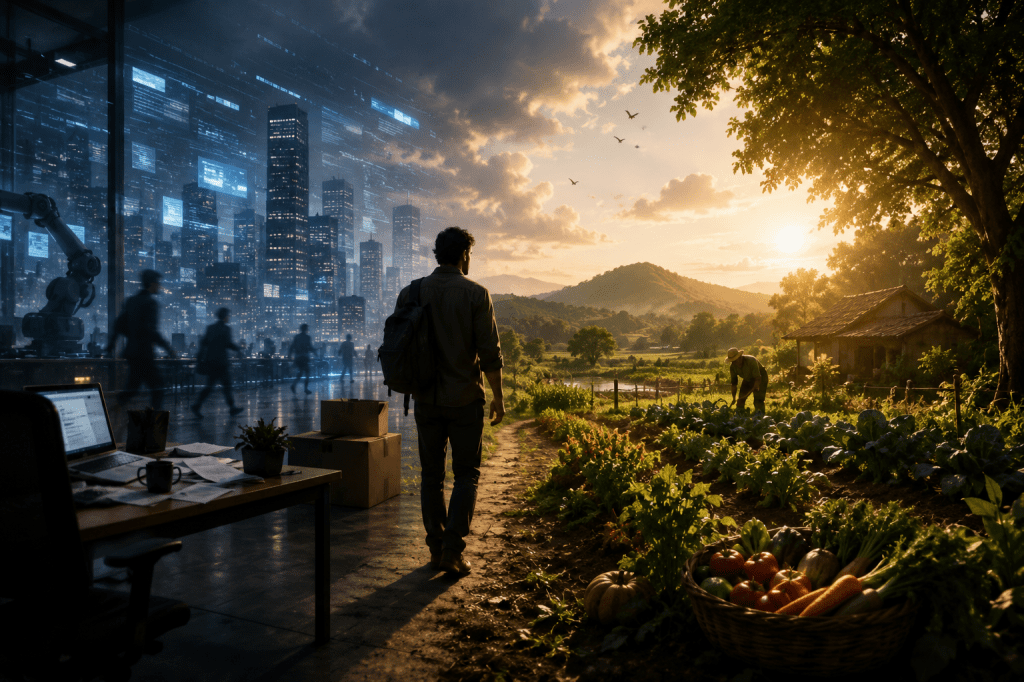
A few decades ago, the world sped up and we were happy to run. The dot-com years pulled us online, and it felt like progress — faster work, faster money, faster everything. We didn’t mind. We chose it.
But the speed never settled. It only compounded. Now AI is accelerating life faster than we can hold, and the ground under our careers has gone soft. Roles change overnight. Layoffs arrive without warning. The job you trained for can be rewritten by next week.
And it is wearing us down. Anxiety and depression tied to work keep climbing — in India, the share of employees reporting burnout rose from 58% to 72% in just three years, the steepest jump anywhere in the world. At the same time, we have quietly drifted from the one thing that used to steady us. We now spend more than 90% of our lives indoors, lit by screens, when for almost all of human history we lived under open sky. We are more connected than ever, and more cut off from the ground beneath us than any generation before. Somewhere in the rush, a quieter question keeps surfacing: what actually lasts?
One thing does. The oldest thing. Food.
It is the most basic human need — older than any market, immune to any disruption. We will need it long after the current gold rush forgets its own name. And yet the quality of what we eat is quietly slipping. The soil is tiring. A tomato today carries less than the tomato your grandparents ate. We grow more and nourish less.
The technology we keep celebrating won’t fix this. If anything, it pulls the other way. Every new wave of AI asks more of the earth — more land, more water, more power poured into data centres that compute but do not feed. They are not making our food better. They were never meant to.
Maybe the problem was never work itself, but the kind of work we chose. So much of our unhappiness comes from labour that pulls against our nature — fast where we are slow, indoors where we are built for sky, urgent over things that will not matter by morning. The happiest work is the kind that does not feel like work at all. Work that moves in step with nature instead of against it. Work whose rhythm your body already knows.
So why farming? The pull comes from slowness. Technology keeps speeding our lives up faster than we were ever built to handle — and somewhere in that blur, we forgot how to stop. Farming runs on a different clock. It moves with the seasons, not the notifications. It is one of the few careers you can also call home — rooted, quiet, yours. And it is yours in a way nothing digital ever is. No tech can take it from you.
But maybe “career” is the wrong word for it. This isn’t a business to optimise. It is a way of living. Slow, sustainable, close to the earth — the kind of life we keep saying we want and keep postponing. You don’t farm to escape work. You farm to remember what work was for.
And there has never been a better time to begin. Not because it is easy, but because everything else has grown so uncertain that the steady thing finally looks wise. The people who feed us are growing old, and few are stepping in behind them. The door is open. You can start small, on the side, learning a season at a time, long before you ever need to lean on it.
We are not doing this only for ourselves. Food is the one inheritance every generation hands to the next. If we let its quality erode while we chase the next faster thing, we leave our children a fuller shelf and a poorer plate. Protecting how food is grown is not nostalgia. It is the most forward-looking thing we can do.
The world will keep speeding up. Let it. Somewhere a field will still keep its slower time, asking only for patience and giving back something no layoff can reach.
No tech can take it from you.
