
“He never reads anything. I’m tired of asking him.”
That was the complaint Alex made about his eight-year-old son.
He was sitting with friends on a bright, sunny afternoon during a picnic. Around them, many people lay quietly on picnic mats, absorbed in books. Hardly anyone was talking.
Alex had grown tired of the usual park activities. A day that was supposed to be relaxing had somehow become exhausting. Looking around, he wished he could spend the afternoon lying on a mat, reading a book under the warm sun, just like everyone else.
Then he realized something.
The last time he had read a book was thirteen years ago.
Since then, he had always been “busy”—household chores, office work, family responsibilities, or simply “something came up.” There was never enough time to read. His friends were no different.
They all agreed that, in the 21st century, the habit of reading was dying. Their children hardly read at all. Instead, they spent hours watching thirty-second videos that demanded almost no attention.
Ironically, none of the parents were readers themselves.
Alex had once loved books. Now he only complained about how children were changing.
The day came to an end, and everyone returned home.
Alex freshened up, took a shower, and turned on the TV. He flipped through several channels before settling on a baking competition where contestants were learning to make elaborate desserts.
His son quietly sat beside him.
It was already 10 p.m.
They watched the show together until both of them fell asleep on the couch. Alex woke up an hour later and realized his son’s bedtime had long passed. He gently woke him up, and they both headed to bed.
The next morning, Alex was tired of making excuses.
He wanted to become a reader again.
It wasn’t that he had a short attention span. In fact, he hated spending an hour mindlessly scrolling, searching for something interesting enough to watch.
He walked to his bookshelf and picked up an old favorite—The Alchemist.
He wasn’t entirely sure why he chose it. Maybe because it was familiar. Maybe because the language was simple. Maybe because it wasn’t too long. He just needed a book that would help him start again.
As he opened the first page, his son appeared beside him.
“Dad, what are you reading?” he asked.
“A book I used to love a long time ago, son,” Alex replied.
Without saying another word, his son walked to the bookshelf and picked a book for himself.
It was 1984 by George Orwell.
Alex smiled.
Then he remembered the children’s books he had borrowed from the library months ago but had never opened with his son. He gently took 1984 from him and handed him one of the illustrated storybooks instead.
His son happily accepted.
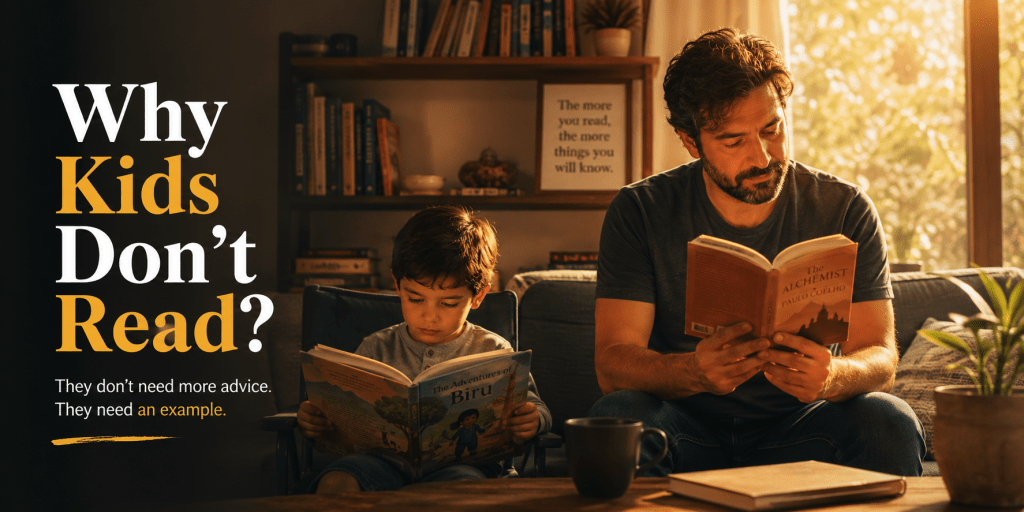
He sat beside his father on a small chair, holding his own book.
On that bright, sunny morning, both of them opened their books and began reading.
His son read aloud, sounding out every word with excitement. Every few minutes he would stop, point at a colorful illustration, and proudly show it to his dad.
Alex continued reading.
Halfway through his own book, he noticed something remarkable.
His son was reading.
Not because anyone had forced him.
Not because someone had lectured him.
Simply because he had seen his father reading.
It didn’t take Alex long to understand.
Children become what they see, not what they are told.
Parenthood is not a default state. It is earned through everyday actions.
Love is not what you preach.
Love is what you practice.
