
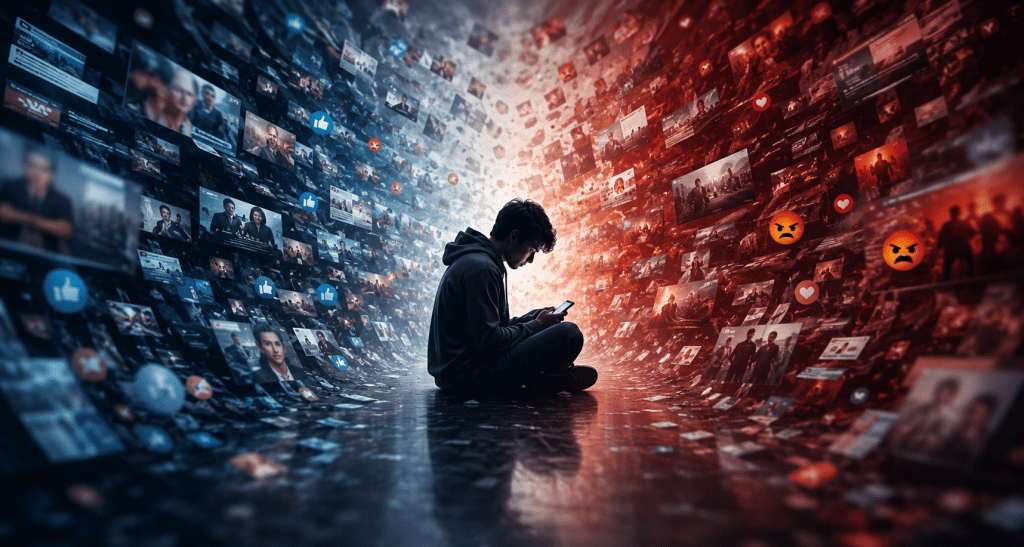
I don’t think anyone chooses to become extreme. That is what makes this worth writing about. Nobody wakes up and decides to move further from the middle. And yet almost everyone I read online seems to have drifted somewhere — far right, far left, certain.
Here is what I think is happening. The algorithm does not know what you believe. It has no position. It only knows what makes you stay. That is all it is measuring, second by second, and everything else follows from it.
What holds attention is not information. It is reaction. A measured take gives you nothing to feel, so it dies in the ranking. A contemptuous one gives you plenty, so it travels. Over a few months the feed stops showing you a topic and starts showing you the most reactive version of that topic. Not the truest version. The one that got a response.
This is also what changed. Earlier, effort decided what reached you. You went looking — a book, a library, an elder who had done the work. It was slow, and being slow it filtered. Only the person who needed the information went and got it. Now nothing filters. Content arrives uninvited, chosen for you by prediction rather than by who you follow, and the thing being predicted is your reaction.
So you end up seeing the worst of the other side and the best of your own. Not by design. By selection. Their most extreme voice pulls more out of you than their most reasonable one, so that is the voice that reaches you. You are left with an accurate picture of nobody, and a confident opinion anyway.
Then you calibrate against it. You see what looks like the other side and you step away. Someone on the other side, looking at a mirror image of your feed, steps away too. Neither of you got more extreme by choice. You both moved to keep a safe distance from a caricature. That is why polarization never feels like radicalization from the inside. It feels like staying reasonable.
I want to be careful here. I am not claiming the science is settled. Researchers who have tested this — including by switching people to plain chronological feeds — have found smaller effects than the filter-bubble story predicts, and some have found these platforms expose you to more opposing views, not fewer. I believe the problem is less about which views you encounter and more about the form they arrive in. A stranger’s face, voice, and tone in six seconds does not persuade the way a paragraph does. It skips the part of you that argues.
There is no way around it. You can reset your interests in those apps, but they will find you again, because you go back to them. The only way is to stop. Stop disrespecting your time so much that you spend it on content created by people with no credentials. If you are curious about a topic, learn to invest time in it. Read a book. Read a long blog. Sit with something that does not want anything from you.
I worry most about the ones growing up in it. A boy picks a career because of a creator he will never meet, while an uncle who did that same work for thirty years sits in the next room, unasked. He isn’t being lied to. He is just being answered before he learns to ask.
Only time will tell whether this shift in who influences us turns out for better or worse. But I keep coming back to one thing. Information that costs nothing to get is treated like it is worth nothing.
