
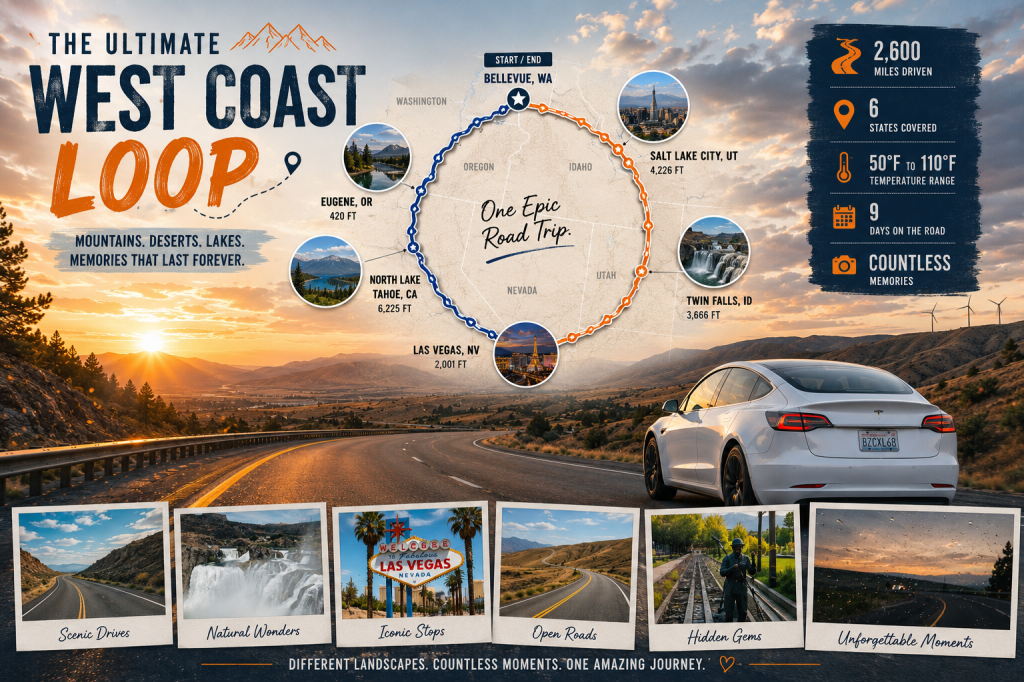
We completed our third major road trip in the United States.
Roughly 2,600 miles, 6 states, temperatures ranging from 40°F to 110°F, and our longest single-day drive touching nearly 850 miles. It was a combination of mountain towns, isolated highways, state parks, deserts, and cities — though the center of the trip was clearly Las Vegas.
Surprisingly, this was one western route we had never done before.
We had driven to San Francisco multiple times by road, but never all the way to Vegas through this loop. Follow for full map here.
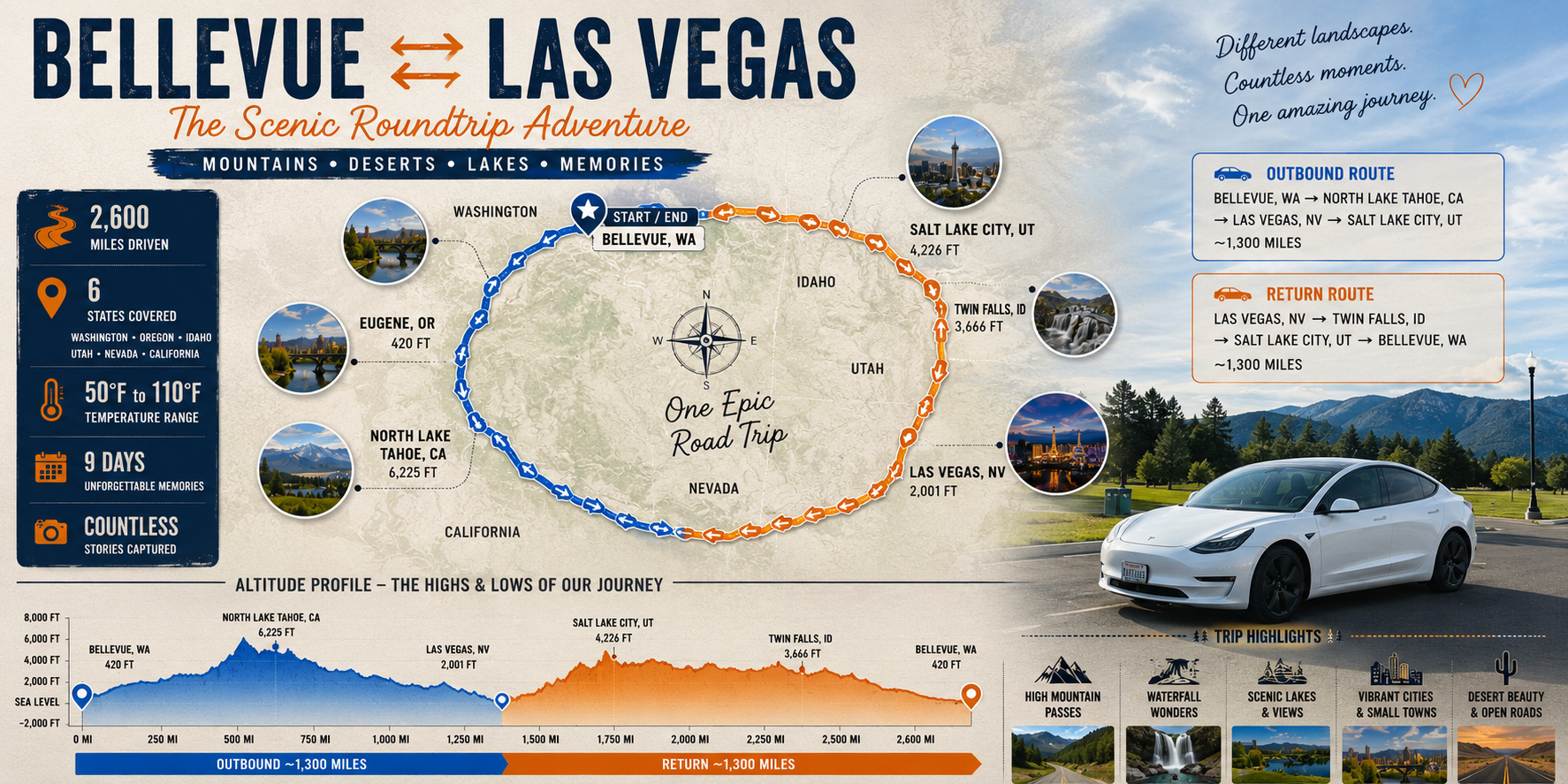
The route started from Bellevue, went down through North Lake Tahoe into Vegas, and returned back home through Salt Lake City and southern Idaho.
Planning
Like most of our road trips, this one was impulsive too.
We finalized it barely two days before departure. Most of the planning time went into deciding the route rather than hotels or attractions. One thing we wanted to ensure was that the trip formed a proper loop instead of repeating the same roads on the way back.
Since we drive an EV, route planning matters more.
An electric vehicle usually adds around 10–20% extra travel time compared to a gas vehicle because of charging stops. But interestingly, those charging stops often become part of the experience itself. Some of the quietest towns, scenic cafés, and unexpected landscapes on this trip were places we would never have stopped at in a normal gas car.
Tesla’s charging network also pushed us toward more scenic highways rather than the fastest interstates. That unintentionally improved the trip.
What We Did Not Visit
This route passes through some of the most famous destinations in the western United States.
One important decision we made early was to avoid getting pulled into every attraction on the map. Otherwise this road trip could easily stretch into a month-long journey.
We intentionally skipped most national parks because we had already visited many of them before. Some major ones near the route included:
- Yosemite National Park
- Yellowstone National Park
- Death Valley National Park
- Zion National Park
Many were only short detours away, which makes them tempting during a road trip.
If you are doing this route for the first time and want to include national parks, it is worth adding several extra days to the itinerary.
Sometimes the hardest part of travel is deciding what not to see.
Modern travel culture pushes us to optimize every trip into a checklist. But road trips become more enjoyable when there is space left for randomness — an unexpected town, a roadside café, a scenic road you never researched, or simply stopping somewhere because the light looked beautiful.
Landscape
This was probably the most enjoyable part of the trip.
It was our first long road trip during summer. Previous trips were in October and December, so the scenery felt completely different this time.
The Seattle-to-Vegas loop almost feels like driving through multiple countries stitched together into one route.
You move through:
- dense forests in Oregon
- snow-covered mountains near Tahoe
- wide open plains
- dry desert landscapes
- dramatic red rock formations in Utah
- isolated highways with barely any cars for miles
Some stretches between Lake Tahoe and Vegas felt extremely remote. Long empty roads, almost no towns, and landscapes changing slowly under harsh afternoon sunlight.
Those drives are beautiful, but it is better to do them during daylight rather than at night.
Summer also changes the emotional feel of the road. In winter, the drive often feels survival-focused — snow, visibility, cold, shorter daylight. Summer driving feels more expansive. Mountains appear larger. Small towns feel alive. People are outside. The roads themselves somehow feel friendlier.
One thing road trips quietly expose is how tightly scheduled modern life has become.
At home, every hour already belongs to something — meetings, routines, notifications, deadlines, sleep schedules. On the road, that structure temporarily disappears. A charging stop becomes a walk. A delay becomes part of the memory. Lunch stretches longer than planned. You stop calculating productivity every hour.
Perhaps that is why road trips feel mentally refreshing despite being physically tiring.
Vegas
We spent most of our time in Las Vegas.
Vegas is a strange city. If you stay only one or two days, it can feel exhausting — heat, lights, casinos, noise, artificial luxury everywhere. But after a few days, the city slows down. You stop trying to “cover Vegas” and instead start living inside it.
Morning gym sessions.
Long walks through hotels.
Trying restaurants.
Watching people.
Late-night conversations.
Doing absolutely nothing for some hours.
The city starts feeling relaxing rather than chaotic.
One interesting realization during travel is that every place rewards a different version of you.
Some people experience Vegas only through gambling. Others through food, luxury, nightlife, architecture, or performances. Mountain towns feel peaceful to some people and lonely to others. The place remains same; the version of ourselves arriving there changes the experience.
Perhaps travel is less about discovering places and more about discovering which version of yourself different places bring out.
Conversations on the Road
One unexpected part of road trips is how often strangers leave a lasting impression.
During the trip we met an elderly couple who had been married for more than 50 years. They were on one of their first long road trips across the country despite being in their seventies or eighties. They spoke about national parks, long drives, losing their dog after many years, and continuing to travel anyway.
The man could barely walk properly.
Yet they had already driven thousands of miles.
Conversations like these quietly stay with you.
They remind you that people continue searching for movement, novelty, and meaning throughout life. There is no final age where life suddenly becomes complete and static.
Life keeps moving.
And perhaps that is why road trips feel symbolic. The destination matters, but movement itself becomes the deeper experience.
Flights compress geography.
Road trips allow you to feel it slowly.
The temperature changes.
The vegetation changes.
The architecture changes.
The roads themselves change.
Somewhere during the drive, the destination quietly stops mattering.
The movement becomes the experience itself.
