
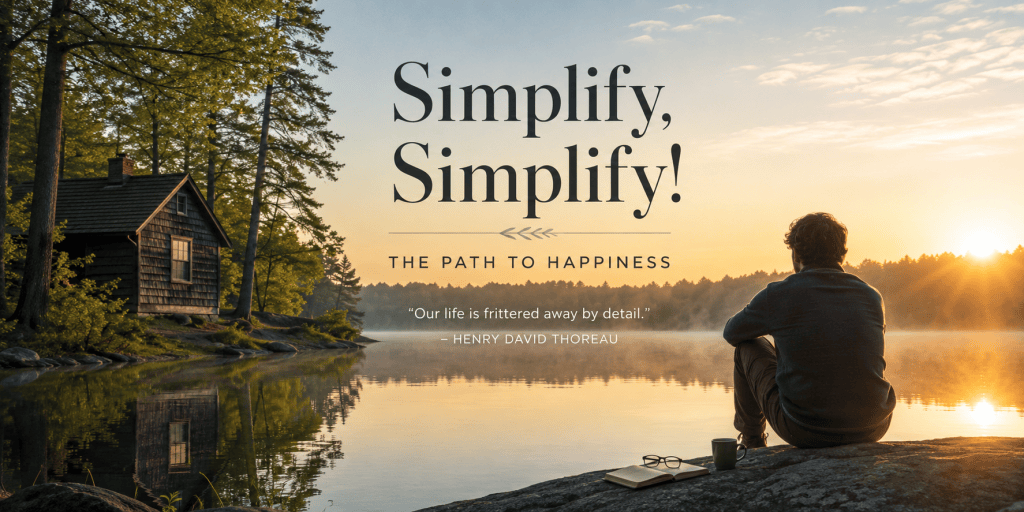
In 1854, Henry David Thoreau published Walden, a book written after his experiment of living simply in a small cabin near Walden Pond. More than 170 years later, his words still feel remarkably relevant. “Our life is frittered away by detail,” he wrote, before offering his famous advice: “Simplicity, simplicity, simplicity!” He was arguing that we often complicate our lives by accumulating things, obligations, expenses, and distractions that we don’t really need. Thoreau believed that by reducing the unnecessary, we create room for what actually matters: time, freedom, nature, thought, and living deliberately. What is striking is that he was making this argument in 1854—and yet it could just as easily describe life in 2026.
After 170 years, if there is one thing humans have certainly made progress in, it is buying more, needing more, and having more—more objects, more possessions, and more choices. As a result, having more things has made life more complicated. This is exactly the opposite of simplicity. Imagine a day when you have only one thing to do—read a book. Have you ever wondered why we enjoy vacations so much? Perhaps it is because, for a short period, we reduce life to a few simple things: visiting new places, eating good food, and enjoying the moment.
Attaining simplicity is not just about reducing the “things” in our lives. It is also about reducing our “wants.” Unnecessary wants may seem attractive at first, but they are bound to cause stress in the long term. A person who owns an expensive car may spend more time worrying about its maintenance than someone who owns a second-hand vehicle. The more we have, the more our minds become attached to those things. Perhaps this is the real cost of having too much: not the money we spend, but the mental space we lose.
Freedom, in many ways, comes from creating empty space in our minds. If we already have too many things occupying our minds—relationships, careers, assets we have purchased, sources of income, health, food, and countless small responsibilities—it becomes harder to manage our time and maintain focus. Lack of focus can directly contribute to unhappiness. The solution is not to own nothing or to live an extremely minimalist life—no. Some of the world’s most successful businesspeople have also recognized the value of simplicity. Steve Jobs said, “That’s been one of my mantras—focus and simplicity. Simple can be harder than complex.” Warren Buffett famously said, “I don’t want a 405-foot boat just because someone else has a 400-foot boat.” Both were making essentially the same point in different ways: having the ability to acquire more does not mean that acquiring more will make your life better.
A simple life is not necessarily a life with fewer possessions. It is a life with fewer threads tied up in your mind. The goal is to create enough mental space to dedicate your mind to what actually matters to you. It can start with simple things. If deciding what to cook bothers you, write down a meal plan on a board and take that decision off your mind. Finish small tasks immediately so they stop occupying mental space. With a little effort toward creating more space in your mind, your choices become simpler.
Life can be much more than what you have.
