
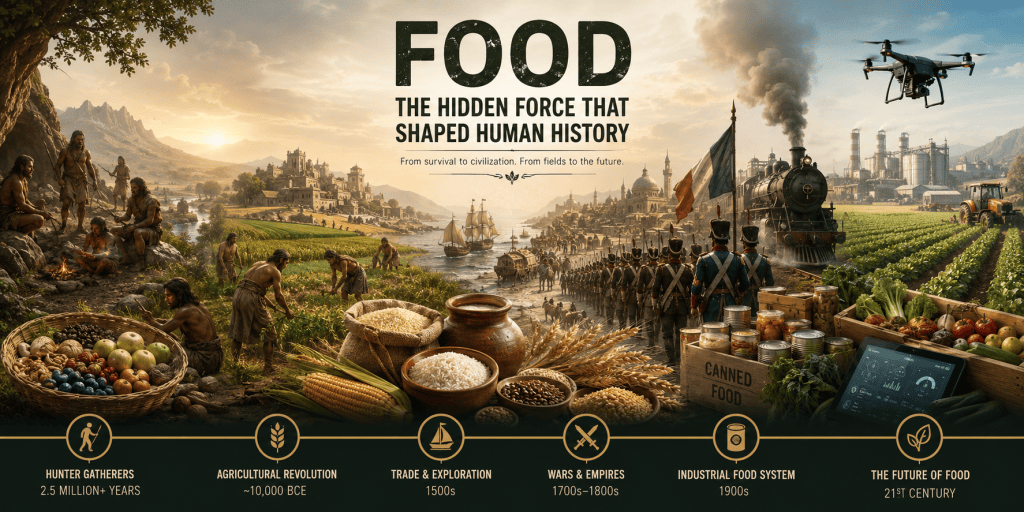
We were hunter-gatherers for most of our existence. If the entire history of Homo sapiens were compressed into one hour, agriculture would have appeared only about 3–4 minutes ago. In other words, the way we live today is extremely recent when measured against the span of human existence. Agriculture began roughly 10,000–12,000 years ago and fundamentally changed how humans ate, lived, settled, organized themselves, and interacted with one another.
For most of human history, food was not simply something we consumed. Food shaped society. The domestication of plants and animals was one of the great turning points in human history. It enabled people to produce, store, and accumulate food, encouraging permanent settlements, population growth, specialization, and increasingly complex social structures.
Hierarchy of Power
The societies that emerged with agriculture were generally more capable of accumulating surpluses than mobile hunter-gatherer societies. And once food could be produced and stored in significant quantities, control over those resources could become a source of wealth and power.
This was very different from many hunter-gatherer societies. Anthropological research suggests that many small-scale hunter-gatherer groups were relatively egalitarian. Food was widely shared, accumulation was discouraged, and excessive pride or attempts at domination could be met with criticism, ridicule, or other forms of social pressure.
That does not mean hunter-gatherers had no leaders. They often had informal or situational leaders—particularly during hunts, migrations, warfare, or other activities requiring coordination. But leadership did not necessarily translate into permanent political power or a rigid hierarchy.
Consider the difference with our modern system. When someone performs exceptionally well today, we often reward them with more status, wealth, responsibility, and influence. This can create a positive feedback loop: success brings resources, resources create more opportunities, and those opportunities can produce even greater success.
That system can be extremely effective at rewarding ability and performance. But it can also amplify inequality. The same mechanism that makes the strong stronger can make it harder for the less advantaged to catch up.
Food and the Power of Armies
Food was also a fundamental constraint on military power.

An army could only move as far and as fast as its food supply allowed. For centuries, military campaigns were therefore as much logistical operations as they were battles.
Napoleon’s armies became particularly effective at moving rapidly across Europe partly because they relied extensively on requisitioning and foraging local supplies rather than carrying every calorie they would need from their starting point. This reduced some of the logistical burden and allowed armies to remain mobile.
But the next major transformation came when humans learned to preserve food for long periods.
In the early nineteenth century, Nicolas Appert developed a method of preserving food in sealed containers, initially in response to the needs of the French military. Napoleon’s government recognized the importance of this work and awarded Appert a prize. Canning subsequently became an important part of military food logistics.
This changed the equation.
Food no longer had to be consumed close to where it was produced. It could be preserved, transported, stored, and distributed across increasingly large distances.
That seemingly mundane technological change—making food last longer—had enormous consequences for what armies, governments, ships, and eventually entire societies could do.
Food and the Age of Exploration
Food and commodities also helped drive the expansion of global trade.
European demand for Asian goods, particularly spices, helped motivate attempts to find new and more efficient trade routes to Asia. Christopher Columbus sailed west in 1492 seeking a route to Asia. Vasco da Gama later reached India by sailing around the Cape of Good Hope in 1498.
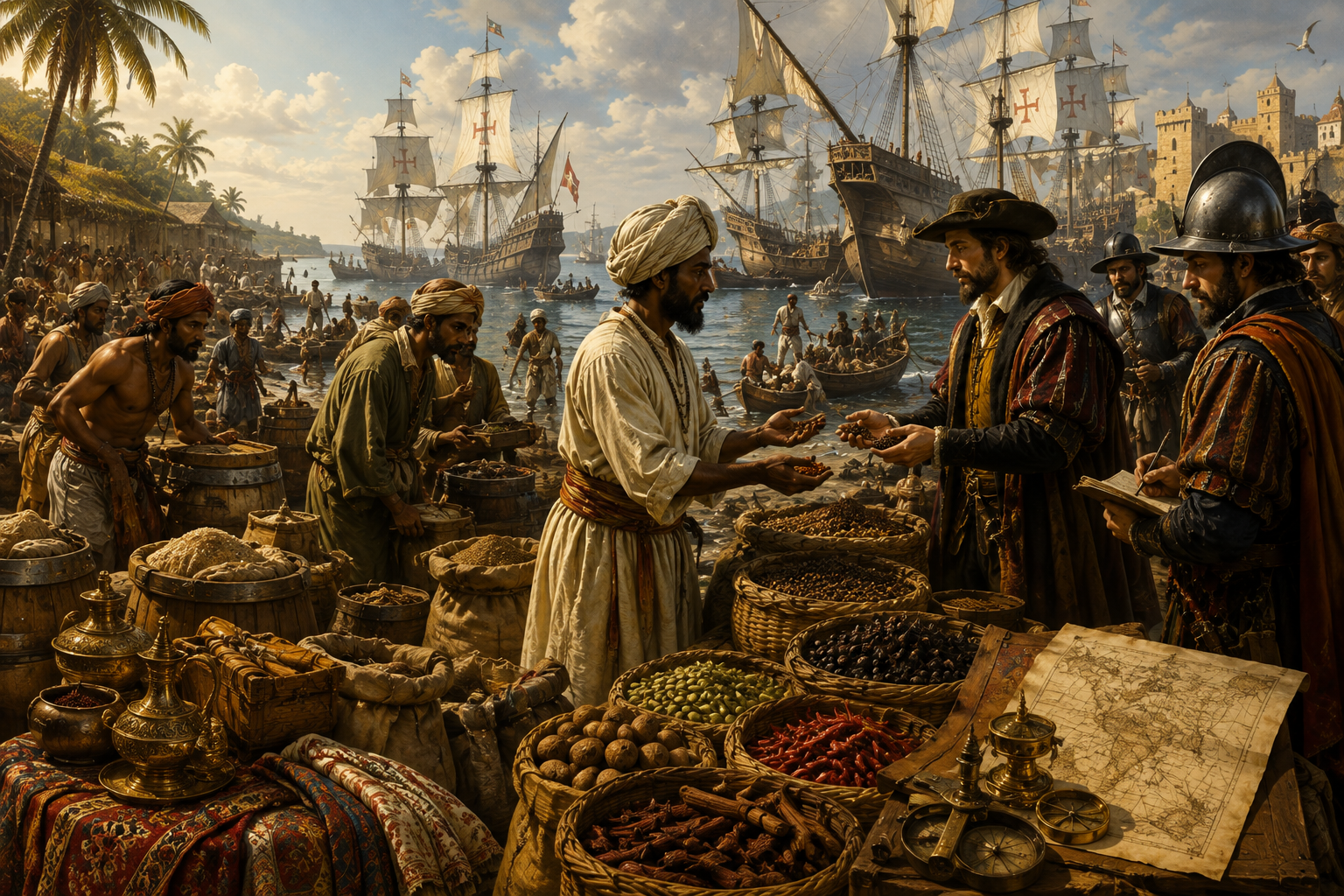
These voyages were not simply adventures of exploration. They were part of a much larger struggle over trade, resources, and economic power.
The consequences were enormous. The resulting expansion of maritime trade connected distant parts of the world on an unprecedented scale and ultimately contributed to the creation of new global economic and political systems.
Food and agricultural commodities were at the center of much of this transformation.
The Invisible Infrastructure of Civilization
This is what makes food such a fascinating subject.
It is easy to look at history through the lens of kings, wars, inventions, money, and political revolutions. But underneath all of them is a much simpler question:
How do you feed people?
Kings depended on agricultural surpluses.
Armies depended on food supply lines.
Cities depended on farms outside their boundaries.
Ships depended on preserved provisions.
Empires depended on moving food and other agricultural commodities across enormous distances.
Governments depended on taxing agricultural production.
And industrial societies eventually depended on increasingly sophisticated systems of food production, preservation, transportation, refrigeration, and distribution.
Food was not merely part of these systems. It was one of the foundations on which they were built.
What Happens Next?
If food played such a fundamental role in shaping the world we inherited, what makes us think it will not shape the world we are building?
We are entering an age dominated by artificial intelligence, automation, biotechnology, and increasingly digital economies. Yet as technology becomes more sophisticated, some of the most fundamental physical necessities of life may become even more strategically important.
Food. Water. Land. Energy.
These are not abstractions. They are physical realities.
The AI era may therefore create an interesting paradox: while much of the world’s attention moves toward increasingly digital technologies, the importance of fundamental resources may become more visible, not less.
Food security, agricultural resilience, soil health, water availability, seed diversity, local food production, and the quality of what we eat could become increasingly important.
The future may not simply be about who controls the most advanced technology.
It may also be about who controls the systems that sustain human life.
The shift may already be beginning. As people become more conscious of food quality, supply-chain vulnerability, climate change, and agricultural resilience, interest in farming, regenerative agriculture, local food systems, and agricultural businesses is likely to grow.
Perhaps this is not a return to the past.
Perhaps it is a recognition of something we temporarily forgot:
Food has always been power.
And if food has played such a central role in making the world we live in, there is every reason to believe it will help shape the world that comes next.
Food is not just a part of human history. It is one of the forces that made human history possible.
