
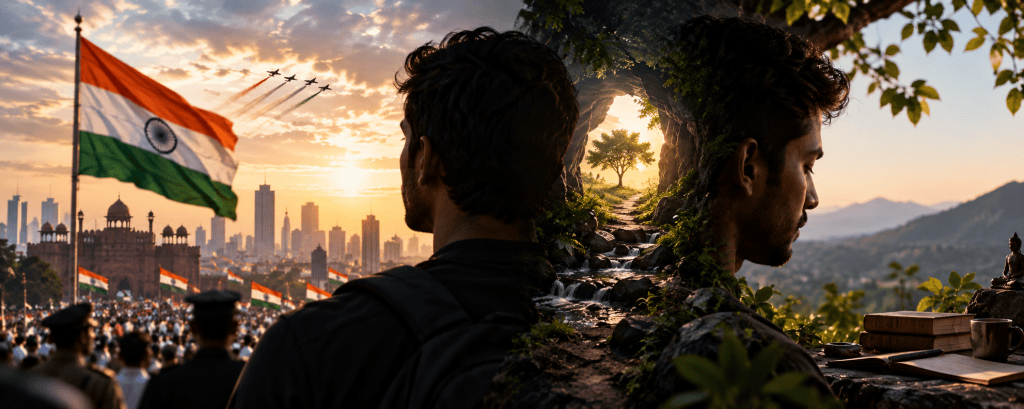
What if people showed even half as much patriotism toward their inner world as they do toward the outer world?
We spend enormous parts of our lives exploring the world outside ourselves. We learn its history, defend its boundaries, build its institutions, protect its symbols, and attach deep emotions to pieces of land separated by lines drawn on maps. But how much time do we spend exploring the world within us?
Our thoughts remain untouched. Our fears remain unnamed. Our authenticity remains undiscovered. Our true calling gets postponed.
We often forget that the soil we feel so strongly attached to is bounded by artificial, paper-defined contracts. Countries that today seem ancient and permanent were, in many cases, not even recognized as independent nations a few decades ago. The decisions that created or liberated many of these countries were made by people who lived before us. Those decisions were not ours. Yet we can spend an entire lifetime feeling responsible for defending them.
Humans existed on this planet long before modern countries, borders, flags, and institutions came into existence. And yet we often choose to leave the one world that has been with us throughout our entire lives—the inner world—largely unexplored. If that is not a lack of self-respect, what is?
The World Within
Perhaps respecting yourself means refusing to ignore yourself. It means paying attention to your true calling, your discomfort, your curiosity, your fears, and the things that quietly make you feel alive. No matter the cost.
For centuries, humans have been taught to love and protect objects and ideas outside themselves—land, buildings, institutions, identities, traditions, organizations, and boundaries. There is nothing inherently wrong with loving these things. The problem begins when we never stop to ask: Do I actually believe in this? Does this serve me? Is this how I want to live? Or have I simply inherited the idea?
We shouldn’t necessarily reject everything that society has handed us. But we should have the courage to question it. Any idea that significantly shapes our lives deserves examination before unquestioned acceptance.
The Cost of Ignoring Yourself
Perhaps this is one reason the idea of a midlife crisis is so common. Feelings that have been ignored for decades don’t necessarily disappear. They accumulate.
The career you never wanted. The relationship you stayed in because it was expected. The dream you kept postponing. The curiosity you never pursued. The person you wanted to become but never gave yourself permission to be.
Eventually, the inner world demands to be heard. What we call a crisis may sometimes be something else: the accumulated consequence of years of insufficient introspection. We spend decades becoming successful at living a life that may not actually belong to us.
Question the Status Quo
Can we question the status quo?
Not necessarily reject it. Question it.
Strip away the assumptions for a moment. Imagine you were starting from the beginning. Would you choose the same education? The same career? The same definition of success? The same lifestyle? The same ambitions? The same things to fear? The same things to chase?
Human history can teach us a great deal, but history cannot create a mould that works perfectly for every human being. Every person is different. What worked for one generation may not work for another. What works for your neighbor may not work for you. And what society celebrates may not necessarily be what your life needs.
The courage to look inward is therefore not selfishness. It is responsibility.
Look at Your Frustration
I want people to honestly examine their lives, especially when they find themselves constantly pointing outward.
When you are frustrated, ask: What is actually causing this frustration? How is it affecting your mood? What decisions is it pushing you toward? Are you becoming someone who constantly blames others? Are you avoiding accountability? Are you living according to someone else’s expectations? Are you becoming a medium through which other people, institutions, or systems achieve their goals?
These aren’t comfortable questions. But uncomfortable questions are often more valuable than comfortable answers. Without introspection, it becomes incredibly difficult to understand what is actually good for us.
Perhaps This Is What Education Is For
We often define education as the accumulation of external knowledge: facts, degrees, skills, credentials, information.
But perhaps education has a deeper purpose.
To learn how to question.
To question the establishment. To question assumptions. To examine the ideas we inherit. To understand ourselves honestly. And ultimately, to find answers that work for our own lives.
Education should not merely teach us how to fit better into the existing world. It should give us the ability to step back from that world and ask: “Is this the world I want to participate in?”
That is hard work.
Looking inward is harder than looking outward because there is nowhere to hide. There is no foreign country to blame. No institution to blame. No border to defend. No ideology to hide behind.
Eventually, there is just you—and the truth you are willing to discover about yourself.
Perhaps that is the greatest patriotism of all:
to take responsibility for the one world that was truly given to you—your own.
