
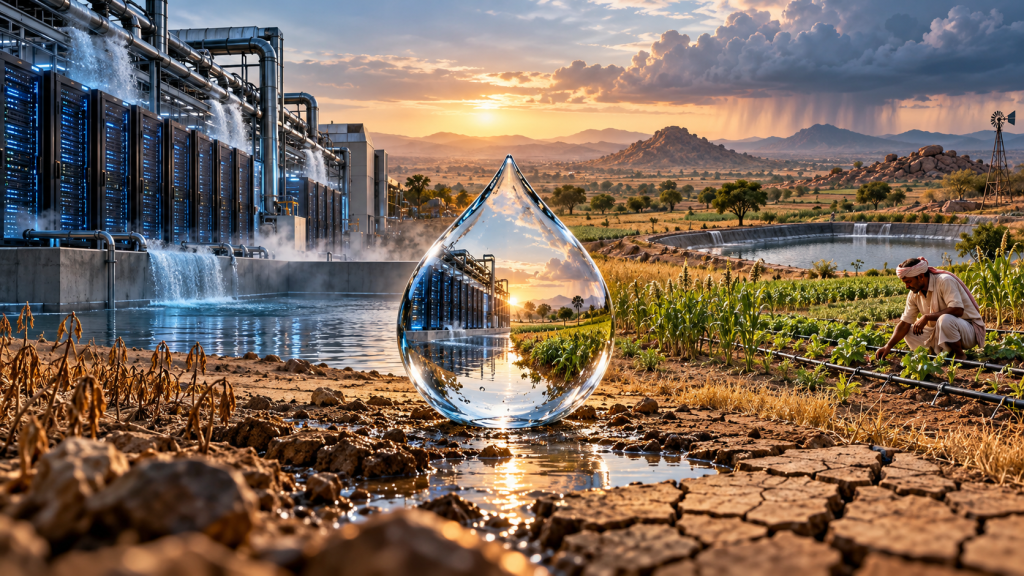
Every time we ask an AI a question, a little water disappears. The computers in data centres get hot, and many are cooled with water that evaporates; more water is used at the power plants that make their electricity. Researchers estimate AI could use 4 to 6.6 trillion litres a year by 2027, and the UN expects data centres to need about 9.3 trillion litres a year by 2030. In India, data centres used about 150 billion litres in 2025, a figure that may more than double by 2030.
That sounds enormous until we look at farming. Farms take about 2,888 billion cubic metres of water a year, roughly 70% of all the fresh water people use. AI’s share is about 0.2% of that. In India, farms withdraw around 688 billion cubic metres a year, about 4,500 times more than data centres. So AI is not the main thirst. But water problems are local. A data centre draws heavily from one spot, all year round, often from the same groundwater that nearby farms and villages need. A few drops matter when the well is already running dry.
And many wells are. In January 2026, a UN University report said the world has moved beyond a water crisis into “water bankruptcy.” For decades we have taken more from rivers, lakes and underground than rain puts back, and some losses cannot be undone: dried lakes, sinking land, melted glaciers. Nearly three-quarters of humanity now lives in countries classed as water-insecure.
The pain will not arrive everywhere at once. The Middle East and North Africa come first: 83% of people there already live with extremely high water stress, and by 2050 everyone will. Bahrain, Cyprus, Kuwait, Lebanon and Oman top the list, and Tehran, a city of 15 million, has already faced “Day Zero.” South Asia will be hit hardest by sheer numbers, with 74% of its people under extreme stress; drought covered 64% of Afghanistan in 2025. Sub-Saharan Africa is changing fastest, with water demand expected to jump 163% by 2050. Mexico, Chile and Egypt are close behind.
India sits at the centre of this story. It pumps more groundwater than the United States and China combined. Population is only part of the reason. Pumping is cheap, there is no limit on how much a landowner can draw, and thirsty crops like rice and sugarcane are grown in dry states. Now data centres are being built in the same water-stressed regions, with little public reporting of the water they use.
It was not always like this. A hundred years ago, most Indian farms ran on monsoon rain, bullocks and seeds saved from the last harvest. Water came from village tanks, canals and open wells lifted by animals, and millets were everyday food. Yields were low and droughts often became famines, but groundwater levels were actually rising for much of the century. The Green Revolution of the 1960s changed everything: high-yield seeds, fertiliser, cheap power and pumps. Foodgrain output grew from about 51 million tonnes in 1950-51 to a record 377 million tonnes in 2025-26. But groundwater’s share of irrigation doubled from 30% to 60%, rice and wheat replaced millets, and India went from hungry and water-wise to well-fed and thirsty.
Yet the future of farming is not hopeless. Drip irrigation can cut water use by a third or more. Millets and pulses need far less water than rice. Farm ponds and recharge pits can catch monsoon rain and put it back underground. Governments can reward farmers for saving water instead of subsidising waste, and require data centres to disclose and recycle what they use. AI itself can help, using sensors and satellites to tell farmers exactly when to irrigate.
The real danger is neither AI nor farming alone. It is taking water faster than rain gives it back. The countries that act early will keep both their farms and their future. Those that wait may find, like Tehran, that the well runs dry before the decision is made.
Sources
- WRI: 25 countries face extremely high water stress
- UNU-INWEH: World enters era of global water bankruptcy
- Mail & Guardian: UN water bankruptcy report
- Insurance Journal / Reuters: AI to double data centre water use
- Bursa: UC Riverside AI water estimates
- Angel One: India data centre water
- Knoema: Agricultural water withdrawal
- Down To Earth: India’s agricultural water withdrawals
- Bharat Notes: India’s groundwater
- GlobalPost: Tehran nearing Day Zero
- Ahram Online: Afghanistan’s water crisis
- BGS/NIH: A century of groundwater levels in India and Pakistan
- RBI: Foodgrain production since 1950-51
- EaseMyPrep: 2025-26 foodgrain estimates
- AgEcon Search: Groundwater and irrigation in India
