
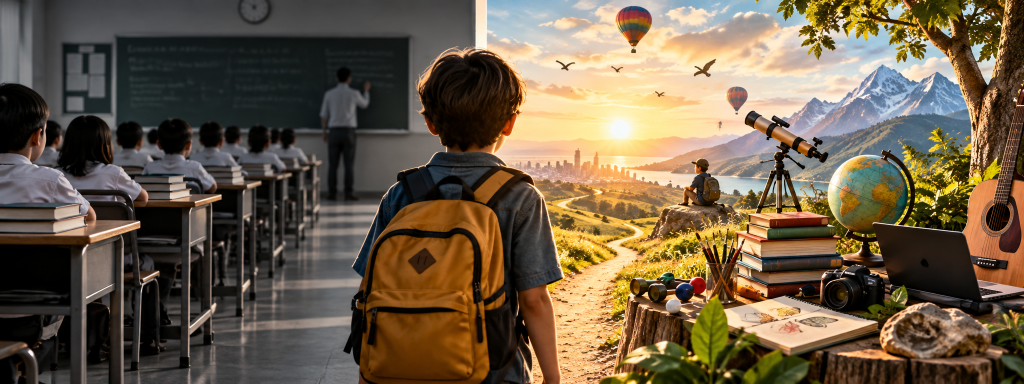
On average, children spend around 16 years in formal education, learning mostly about things discovered, created, or decided by other people. It is supposed to “prepare” them for the outside world. But I am not sure formal education was ever designed primarily to discover a child’s inner potential or help them become the best version of themselves. Everybody seems to be measured using roughly the same scale. You have a natural talent for music—you study history. You have extraordinary potential in sports—you study history. You are genuinely fascinated by civilizations and events of the past—you too study history. How can billions of children, with completely different minds, interests, abilities, and circumstances, be expected to learn largely the same things at roughly the same age and pace? And what does that leave for parents? We use whatever time remains outside school to discover our children’s talents, nourish their interests, turn those interests into hobbies, and hope that someday they find their own way. Instead of giving children substantial time to explore what naturally pulls them, we often squeeze those interests into the margins of their lives. At best, they become hobbies.
Much of what I learned in school, I rarely use in life. And many of the abilities I rely on most were never taught to me in school. Learning independently. Keeping pace with a constantly changing world. Developing the desire to understand something simply because you are curious about it. Improving yourself without somebody assigning you a syllabus. Changing your mind when you discover better information. These abilities are often developed through parents, family, friends, mentors, work, failure, experimentation, and life itself.
But are schools really that bad? No. School is not useless. It can provide something extremely valuable: a social environment. Children make friends, encounter people different from themselves, learn routines, meet deadlines, work in groups, and experience some independence from their families. A structured curriculum can also be enormously important for children whose families lack the time, resources, knowledge, or stability to provide educational opportunities themselves. Universal schooling has played an important role in expanding literacy and access to education. The problem begins when we confuse access to schooling with the complete education of a human being. Today, many of us outsource almost the entire responsibility of education to schools—sometimes because we do not have time, sometimes because we trust institutions more than ourselves, and sometimes simply because that is what everybody does. School can be a wonderful place to build friendships, discipline, and foundational knowledge. Just do not assume that attending school alone will discover and develop everything extraordinary about a child.
This becomes even more important in a world transformed by AI. Answers are becoming cheaper. The device in your palm already contains more factual information than any individual could memorize in a lifetime, and AI increasingly allows us to retrieve, summarize, explain, and interact with that information instantly. That does not mean everyone suddenly becomes equally knowledgeable. Quite the opposite. When answers become abundant, the difference between two people increasingly comes down to the quality of the questions they are capable of asking.
Questions may become one of the most valuable intellectual skills of the coming era. Yet our education system still overwhelmingly rewards answers. Imagine studying Mahatma Gandhi and, instead of being given ten questions to answer, being asked: Write ten questions about Gandhi that you genuinely want answered. Suddenly the exercise becomes completely different. The child has to think before searching. What do I find strange? What do I disagree with? What am I curious about? What doesn’t make sense? What would I ask Gandhi if he were sitting in front of me? The purpose is no longer to reproduce information. It is to generate curiosity.
Curiosity has always mattered, but historically access to information itself was a major barrier. If you had books, teachers, libraries, educated parents, or access to intellectual circles, you possessed an enormous advantage. Today, billions of people carry access to extraordinary amounts of information in their pockets. AI is lowering that barrier even further. Access to information will therefore matter less as a differentiator. Knowing what to look for, what to question, what to investigate, and what deserves your attention will matter more.
That is why I think parents need to reconsider the assumption that education and schooling are the same thing. I am not necessarily saying: pull every child out of school tomorrow. I am saying: unschool their mind. Do not let the curriculum become the boundary of their education. Give them unstructured time. Let them become obsessed with something. Let them build things that fail. Let them spend a month learning about dinosaurs, filmmaking, insects, chess, machines, trees, music, mathematics, cooking, or whatever captures their imagination. Let them ask questions for which you do not know the answers. Better yet, investigate those questions together.
If your child spends most of their childhood inside the formal education system, ask yourself what that system is actually providing—and what it is not. Something having worked for generations does not guarantee that it will work in exactly the same way in a radically different world. The world our children are entering is not the world for which our education system was originally designed. Perhaps our responsibility as parents is no longer merely to make sure children learn enough answers. Perhaps it is to make sure they never stop asking questions.
