
No matter how many ways I think about the future of employment, I keep coming back to one answer: agriculture.
I have spent 16 years in the software industry. For the last 1.5 years, I haven’t written a single line of code without AI. And I have written a lot of code. The speed and quality at which AI can now generate software is difficult to comprehend. Humans are simply not in the same race anymore. The same transformation is happening across industries that depend on digital labour—writing, coding, research, design, analysis, and even parts of art. We are approaching a time when humans may be outclassed by employees that can work continuously, improve themselves, and require little human intervention. The idea of having one job for 40 years is already becoming almost unimaginable. Job security has been shaken. So what could be an alternative? To answer that, we need to go back to first principles.
The fundamental reason humans work is simple: to provide food and shelter for themselves and their families. Everything else—better homes, cars, appliances, travel, entertainment—is important for comfort, but food is not optional. The pandemic reminded us of this. When a real crisis arrives, food security becomes one of humanity’s first concerns. So why can’t agriculture become an alternative?
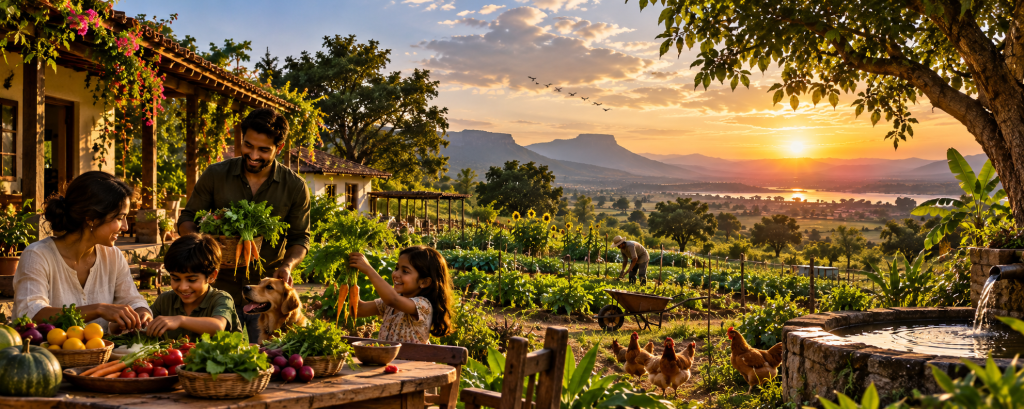
But I don’t mean agriculture as another career in the traditional sense. That may be the wrong way to think about the future altogether. The very concept of a career may begin to blur. For generations, we have organized life around getting educated, finding a profession, working for decades, earning money, and using that money to create the lifestyle we want. But if technology makes human labour less necessary across many professions, perhaps we will need to rethink the relationship between work and life itself. Agriculture is not simply something you do to earn a living. It is a lifestyle you learn to live. You live with the soil, understand water, seasons, plants, weather and the ecosystem around you. You grow some of your own food and become connected to a piece of land and the community around it. You may still work with technology, run a business, consult, create or do other forms of work. But your life becomes less dependent on selling your digital labour to an employer.
Agriculture provides more than food. It provides land, space, freedom, community, and a different pace of life. Comparing agriculture directly with services or manufacturing misses something important. In most professions, you work in a certain way to earn the lifestyle you want. In agriculture, you have to live the lifestyle to become good at it.
It is also fundamentally local. A software engineer can build software for almost anywhere in the world. A farmer cannot farm “globally.” Every place has its own soil, water, climate, crops, pests, and traditions. Becoming a good farmer requires understanding a particular piece of land.
To me, agriculture has the potential to solve several problems at once: food security, lifestyle, mental health, freedom, and our growing disconnection from nature.
As food systems become increasingly dependent on chemicals and industrial processes, concerns around food and lifestyle-related health are growing. Children are also becoming increasingly disconnected from nature, spending much of their lives inside a digital and material world. Farming introduces slowness. It forces us to observe rather than constantly react. It reminds us that we are not separate from nature. We are nature.
There is something deeply satisfying about touching soil, watching a seed become a plant, or eating something you grew yourself. Perhaps children instinctively understand this better than adults do.
Land may also become increasingly valuable as populations grow and climate change puts pressure on food production. Agriculture could become a critical bottleneck in a world where digital labour is abundant but physical resources remain limited.
And perhaps that is the irony of the AI era. As more of our work becomes digital, we may need to reconnect with the physical world more than ever.
Humans are not digital beings. We are biological beings. We can feel happiness by touching a plant. We can find meaning in growing food. We can build communities by supplying healthy food to people around us. We can rediscover a relationship with nature that existed long before the digital era.
The choice is yours.
Would you rather wait to be pushed out of the system, or take ownership of your life before the system decides for you?
With a little first-principles thinking, the direction is not difficult to imagine. As digital labour becomes increasingly abundant, I believe humans will eventually place a higher value on what machines cannot replace so easily: land, food, nature, physical work, community, and meaning.
So why wait?
Maybe the future of employment isn’t somewhere ahead of us. Maybe it is beneath our feet.
